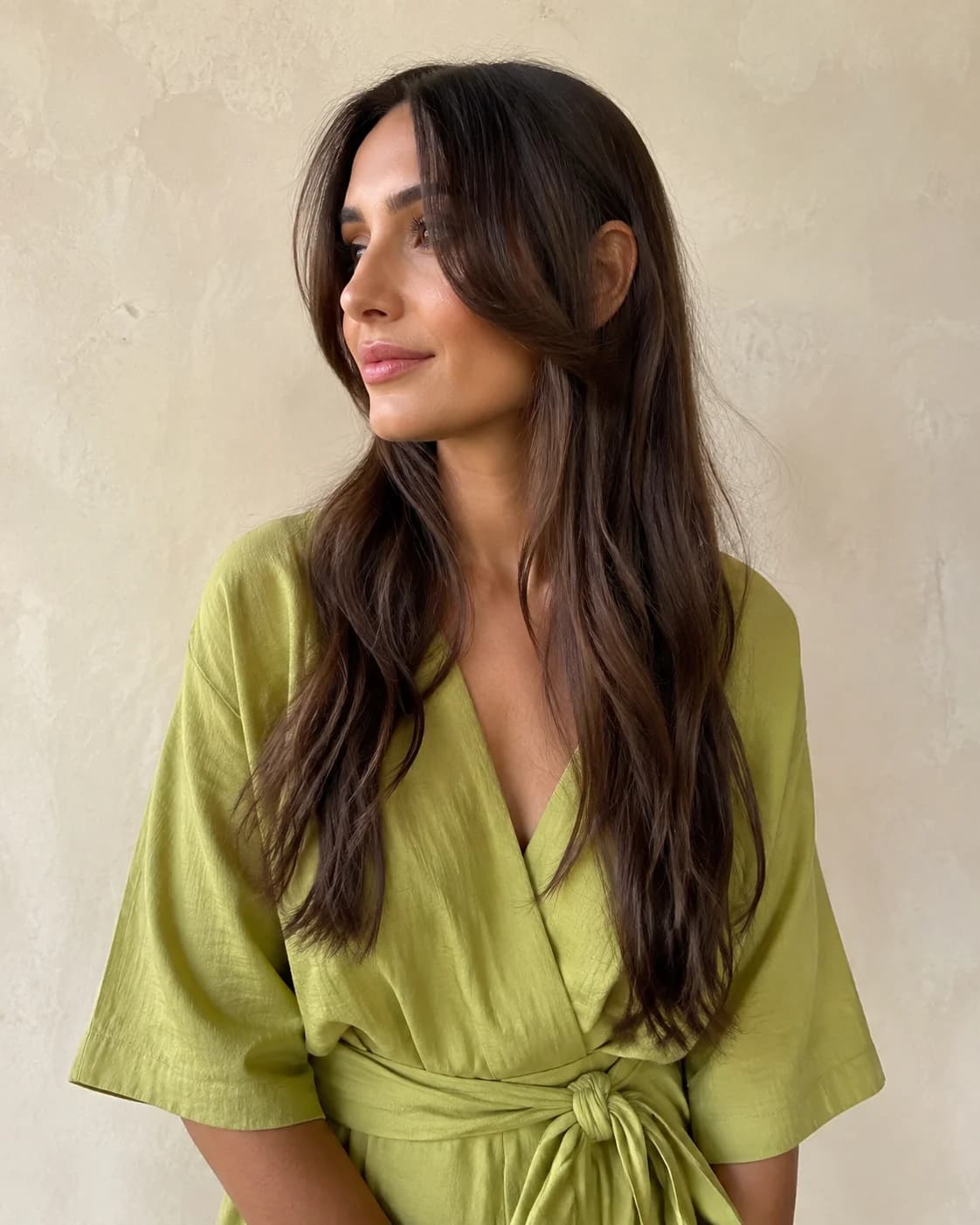
Begin with where the hair is meant to live
Bangs are deliberately brought forward to occupy space around the forehead, brows, or eyes. Face-framing layers usually begin farther to the sides or lower on the face and remain connected to the main haircut. Online references often blur those categories, so the label alone is unreliable.
Ask whether you want the front section to remain visible when the rest is tied back. If yes, you may be choosing a fringe. If you want the option to tuck or sweep everything away from the forehead, a longer face frame may fit the behavior better.
Set the shortest dry point
A piece at the brows, cheekbone, jaw, and collarbone creates a different commitment even when all four are called framing. Point to the exact place the shortest section may land when the hair is dry and worn in your usual texture.
Allow for shrinkage, bend, cowlicks, and the way the front lifts after washing. When uncertain, leave the first version long enough to evaluate in motion. The position can be refined; a section cut too short cannot be returned.
Do not ask only for “long bangs.” Name the shortest acceptable dry point and what the pieces must still be able to do.
Compare section width and connection
A wide fringe takes more hair from the front and temples, while a narrow face frame can preserve more density in the perimeter. Study where the reference section begins at the top and how it connects into the sides. The connection determines whether the front looks integrated or deliberately separate.
For fine or lower-density hair, ask how much fullness will remain outside the section. For dense hair, ask whether the front needs internal weight removed to fall cleanly. The goal is not simply more or less hair; it is a section that belongs to the total silhouette.

Test the ordinary styling routine
A fringe often needs attention earlier in the drying process because the hairline begins setting while damp. Face-framing layers may be more forgiving, but the dramatic sweep shown in references can still depend on a brush, rollers, or heat. Separate the ease of the cut from the effort of the finish.
Explain your part, wash schedule, exercise routine, glasses, and whether you usually tuck the front away. Ask for one polished method and one low-effort method. The lower-effort version is the better test of whether the front section fits your real week.
Choose the maintenance calendar
Short bangs announce growth quickly because the line approaches the eyes. Longer face-framing pieces often change more gradually, although they can lose their connection to the rest of the layers. Ask what will need reshaping first and whether the front can be trimmed separately.
If frequent appointments are not realistic, choose a starting shape with an acceptable second state. A fringe that can open into curtains or a frame that can tuck behind the ears provides a clearer route between full haircut appointments.
Bring a comparison pair to the chair
Save one reference with visible forehead coverage and one with longer, more removable framing. Keep texture and overall length as similar as possible. Compare only the front: shortest point, width, part, connection, and how much remains outside the tie-back.
Tell the stylist which behavior matters most. “I want a visible change, but every piece must tuck behind my ear” is a more useful instruction than choosing between two inconsistent names. Let the final technique respond to your growth pattern and density.
Three terms that make this conversation clearer.
You do not need to prescribe technique. Use these words to describe the visible structure, name the behavior you want, and ask what your stylist would adapt.
Bottleneck bangs
A trend label generally used for a fringe that is shorter or narrower through the center and curves into longer pieces at the sides. Because references vary widely, study the shortest point, center width, side connection, and amount of forehead coverage instead of relying on the name.
SAY IT IN THE CHAIR“I like the narrow center and longer sides in this image, but I want the shortest point to stay below my brows.”Open full definition
Fringe / bangs
Hair intentionally sectioned and cut to live around the forehead, brows, eyes, or upper face. Fringe and bangs refer broadly to the same idea; regional language differs, while section width, density, dry length, and growth patterns determine the real behavior.
SAY IT IN THE CHAIR“Please show me how much hair will enter the fringe and where the shortest point will sit when dry.”Open full definition
Growth pattern
The direction hair naturally leaves the scalp and moves through areas such as the front hairline, crown, nape, and around the ears. Cowlicks, whorls, and directional changes can alter how short sections lift, split, or settle.
SAY IT IN THE CHAIR“Can we look at the front and crown dry before choosing the shortest length?”Open full definition
Turn this guide into a decision.
Three honest answers are more useful than ten additional reference photos. Your responses stay on this page and can be changed at any time.
- 01Do you know the shortest dry point you are comfortable wearing?
Decide where the center and outer corners may land before discussing the fringe name.
- 02Have you named the boundary you do not want traded away?
Examples: tie-back length, full ends, an open forehead, dry length, or support for natural texture.
- 03Does the plan fit your real styling and maintenance rhythm?
Count ordinary mornings, fallback styles, trim frequency, and the way the shape is likely to grow.
The short answers.
Are face-framing layers easier to grow out than bangs?
Longer framing usually blends into the main haircut more easily, but the result depends on its shortest point, section width, and connection to the remaining layers.
Can face-framing layers cover the forehead?
They can sweep forward, but a section designed to live over the forehead behaves more like bangs. Show the intended placement instead of relying on the name.
How this guide was built.
HairChapter separates haircut structure from styling, trend names, and medical claims. Our recommendations are decision tools, not universal rules: a stylist should adapt the direction to your starting length, density, pattern, condition, growth habits, and normal routine.
We do not claim that a photograph or AI preview can predict a finished service. Sudden shedding, patchy loss, scalp pain, persistent irritation, or an unexplained change in density belongs with a qualified medical professional—not a haircut guide.