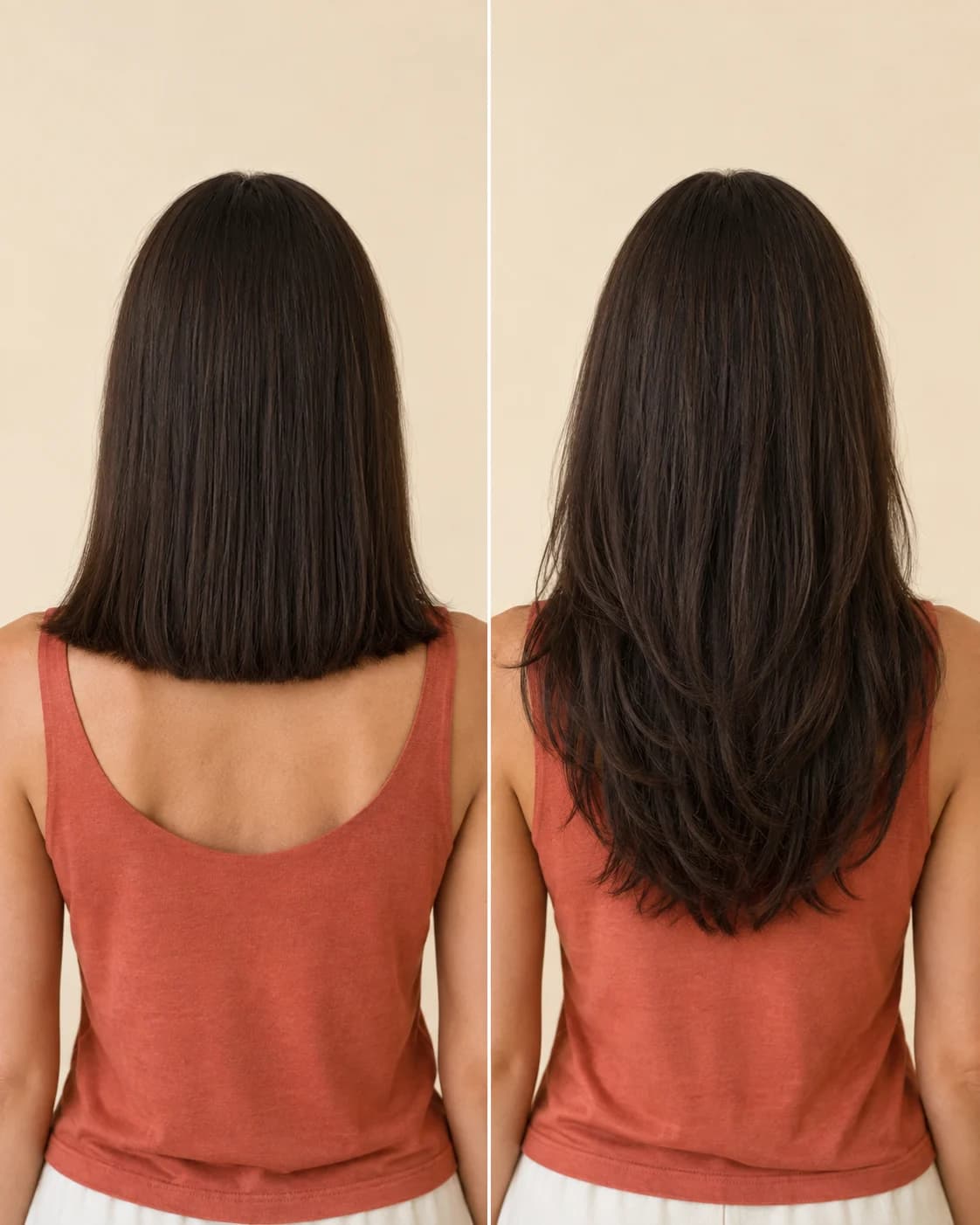
You do not need to speak like a stylist. You need enough language to point at the structure, understand the trade-off, and ask a better question.
Terms
33
Categories
05
Rule
Describe, don't prescribe
READ THE DIFFERENCE
Perimeter describes the outside line. Layers describe how length and weight move inside it.
THE WORKING INDEX
Find the word behind the shape.
33 terms shown
01Hair & routine
Air-dry shape
The silhouette and movement your haircut creates without a blow-dryer, iron, rollers, or deliberate heat styling. It is one of the most useful reference states because it reveals how the cut works with your ordinary pattern, density, products, and drying habits.
Say it in the chair“Please assess the shape my hair makes when I air-dry, even if we choose a more polished finish today.”
The lower edge or foundation of a haircut, especially visible in bobs and other compact shapes. A strong baseline can make the ends read as fuller and more graphic; a softer or broken baseline can make the outline feel lighter and less exact.
Say it in the chair“I want the bottom line to feel complete, but not so sharp that the grow-out looks abrupt.”
A fringe designed to read as a clear, comparatively solid line rather than separated wisps. The final effect depends on section width, density, dry length, natural movement, and finishing—not only on whether the ends were cut straight across.
Say it in the chair“Show me the proposed width and dry landing point before we decide how strong the line should be.”
A short-to-medium haircut whose perimeter commonly lands between the ear and jaw or lower neck. The name does not specify one technique: a bob can be blunt, graduated, layered, rounded, angled, sleek, textured, or adapted to curls and coils.
Say it in the chair“The dry landing point I like is here; how should the perimeter and internal shape change for my texture?”
A trend label generally used for a fringe that is shorter or narrower through the center and curves into longer pieces at the sides. Because references vary widely, study the shortest point, center width, side connection, and amount of forehead coverage instead of relying on the name.
Say it in the chair“I like the narrow center and longer sides in this image, but I want the shortest point to stay below my brows.”
A long layered shape known for shorter sweeping pieces around the face and longer layers through the foundation. Its dramatic winged separation is often amplified by a blowout or rollers, so compare the underlying perimeter and layer map separately from the finish.
Say it in the chair“How much of this movement will come from the cut, and how much will I need to create with styling?”
A haircut intended to land around the clavicle or collarbone. It sits within the broader lob family, but the exact relationship to the shoulders matters: ends that clear, touch, or rest on clothing can bend and move differently.
Say it in the chair“Can we choose the dry length by how the ends meet my shoulders rather than by the trend name alone?”
A short, usable description of the result you want and the reality it must support. The strongest brief combines one structural change, one non-negotiable boundary, your normal styling routine, and a question that invites the stylist to adapt the plan.
Say it in the chair“I want to change this, keep this boundary, and make sure the result still works when I style it this way.”
Shorter sections placed around the upper back and top of the head to influence lift, movement, or roundness. Their effect depends strongly on density, pattern, growth direction, and styling; shortening the crown can also create expansion rather than controlled volume.
Say it in the chair“Where would the shortest crown layer sit dry, and what will it do without a blowout?”
A center-opening or off-center fringe that moves away from the face and connects into longer side pieces. The term covers many lengths and widths, from a visible brow-level fringe to cheekbone pieces that behave more like face framing.
Say it in the chair“I want the center to open easily and the sides to connect here; how wide should the section be?”
The amount of hair growing across an area of the scalp, not the thickness of each individual strand. Density can vary across the same head and changes how much visual weight a perimeter, fringe, or layer plan can retain after hair is removed.
Say it in the chair“Which areas have enough density for this layer plan, and where should we protect visual fullness?”
A deliberate separation between sections that are not blended into one continuous progression of length. It can create strong contrast, preserve length beneath shorter movement, or produce an expressive silhouette; it can also make the grow-out more visibly staged.
Say it in the chair“Is this shorter area connected to the length, and what will the difference look like as both sections grow?”
A technical idea describing how hair is lifted away from its natural fall while a shape is created. Different elevation choices can influence graduation, layering, and weight, but clients do not need to prescribe an angle; the useful conversation is about the visible result.
Say it in the chair“I want movement here while keeping the bottom visually full—what layer plan supports that?”
Shorter pieces concentrated around the front of a haircut to create movement or emphasis near the face. The first dry landing point, section width, part, and connection into the remaining length determine whether the frame feels subtle, dramatic, or fringe-like.
Say it in the chair“Keep the shortest piece at this point and enough length for every front section to tuck back.”
Hair intentionally sectioned and cut to live around the forehead, brows, eyes, or upper face. Fringe and bangs refer broadly to the same idea; regional language differs, while section width, density, dry length, and growth patterns determine the real behavior.
Say it in the chair“Please show me how much hair will enter the fringe and where the shortest point will sit when dry.”
A progressive build-up of weight created through shorter lengths beneath longer ones. Graduation can support a rounded bob, control the nape, or create a fuller-looking shape, but the amount and placement should respond to texture, density, and the desired outline.
Say it in the chair“I like the fullness in this shape—where is it built, and will that placement work with my natural texture?”
The direction hair naturally leaves the scalp and moves through areas such as the front hairline, crown, nape, and around the ears. Cowlicks, whorls, and directional changes can alter how short sections lift, split, or settle.
Say it in the chair“Can we look at the front and crown dry before choosing the shortest length?”
The mass and density held inside the visible outline of a haircut. Thoughtful internal removal can make dense hair move or sit closer without automatically weakening the perimeter; poor placement can create short pieces, expansion, or transparent ends.
Say it in the chair“Where will you remove weight, and which parts of the outline will stay visually solid?”
A plain-language way to describe where the shortest layers begin, how quickly they connect to longer sections, and where movement or volume is intended to appear. Two haircuts with the same overall length can feel completely different because their layer maps differ.
Say it in the chair“Show me the shortest layer, where it connects, and how much weight remains beneath it.”
A long bob, usually sitting somewhere between the lower neck and collarbone. The category is broad: a lob can clear the shoulders, touch them, or rest on them, and that landing point can change movement, tie-back ability, and how the ends turn.
Say it in the chair“I want a lob that still ties back; where must the front and perimeter land when dry?”
Layers that preserve a smaller difference between the shortest and longest sections or begin lower in the haircut. They can add movement while protecting more perimeter weight and tie-back flexibility, although the visible effect may be subtle without styling.
Say it in the chair“I want movement without a large gap between the shortest layer and the perimeter.”
The period during which a haircut still performs the job it was designed to do before a particular detail needs reshaping. The true window is set by the first meaningful change—often a fringe, nape, perimeter, crown, or loss of internal balance.
Say it in the chair“Which detail will stop working first, and what is a realistic return window for that part?”
The outside boundary of the haircut: the line you read around the bottom, sides, and overall edge. A compact perimeter usually feels fuller and more controlled, while a broken or highly layered perimeter can feel lighter, softer, or more textured.
Say it in the chair“I like the movement, but I want the outside edge to remain substantial when the hair is straight or air-dried.”
A broad family of short cuts shaped through the crown, front, ears, sides, and nape. A pixie can be close and graphic or longer and soft; the distribution of length matters more than the label when planning styling and grow-out.
Say it in the chair“Which areas can stay longer so the first version has more styling and grow-out options?”
A layered haircut typically built around visible movement, shorter crown or face sections, and a lighter or more broken perimeter. The amount of crown contrast, fringe, and retained weight varies widely, so one shag reference is not a universal cutting plan.
Say it in the chair“I like the crown movement, but how much fullness can remain through the lower outline?”
Layers that begin higher or create a larger difference from the longest part of the haircut. They can produce visible lift, separation, or a more dramatic silhouette; they also remove weight and may create additional width depending on texture and placement.
Say it in the chair“Where will the shortest layer land dry, and what happens to the fullness in the ends?”
The difference between stretched or wet length and the position hair takes when dry in its usual pattern. Shrinkage is not uniform across every section, so a useful haircut plan considers the dry silhouette and the shortest springing areas rather than one overall number.
Say it in the chair“Please choose the shortest pieces from their dry position and account for the sections that spring the most.”
The complete outside shape a haircut creates when viewed as a whole: compact, rounded, triangular, elongated, wide, narrow, or deliberately irregular. It is often the most reliable feature to compare before discussing small details or a polished finish.
Say it in the chair“I want this overall shape, but I am open to changing the internal technique for my hair.”
The diameter of an individual hair strand, commonly described as fine, medium, or coarse. It is different from density: someone can have many fine strands or fewer coarse strands, and the two facts can lead to different decisions about layers and perimeter weight.
Say it in the chair“Can we separate my strand thickness from my overall density before choosing how much weight to remove?”
A broad term for techniques used to alter bulk, separation, softness, or movement within a haircut. It does not describe one tool or outcome. Ask where the change will happen and what it is intended to do rather than requesting texturizing everywhere.
Say it in the chair“Which area needs more separation, and how will the technique affect my ends and grow-out?”
A visible concentration of weight where lengths meet or stack within the haircut. It can make a bob feel deliberate, build roundness, or create a strong horizontal impression. Its position matters more than whether the term itself appears in your reference caption.
Say it in the chair“I like where this shape feels fullest—can we place that weight at a similar dry position?”
A lighter-looking fringe with visible space or separation between pieces. The result may come from a smaller section, fine density, broken ends, or styling, and each creates a different grow-out and level of flexibility.
Say it in the chair“I want visible space through the fringe without making the center look accidental or too sparse.”
A loose trend category usually combining strong crown layering, visible contrast, face movement, and a comparatively lighter lower outline. Some references lean close to a shag; others preserve a longer tail. Compare the actual layer map instead of expecting the name to be standardized.
Say it in the chair“Which part of this reference makes it feel like a wolf cut, and can we keep more weight in the perimeter?”
Vocabulary should improve the conversation—not replace expertise.
Technique names can vary between stylists, training systems, textures, and regions. Use these definitions to describe the visible result and the behavior you want. Let the professional holding the hair choose and explain the safest technique.