
Haircuts for cowlicks begin with the place that moves
Haircuts for cowlicks are not one list of approved styles. A front section that opens into a part, a crown that spirals, and a nape that grows upward create different design problems. The best cut is the one whose shortest, most visible sections still make sense when that hair falls on its own. Start by letting freshly washed hair dry as you normally wear it. Notice the point where it lifts, separates or reverses direction. Then decide whether you want to use that movement, soften its appearance or spend time directing it elsewhere.
A growth pattern is the direction in which hair emerges and settles; density and length affect how much scalp the part shows. If an area is newly changing, painful, inflamed or shedding, a haircut guide is not a diagnosis and a clinician is the appropriate person to ask. Milady’s professional haircutting guide treats growth pattern alongside density, texture and wave pattern, which is the right level of caution.
First locate the pattern. “I have a cowlick” is less useful than “the right front lifts upward when dry.”
Make a three-zone map before choosing a silhouette
Take front, side and back photographs in your usual dry texture and part. At the hairline, look for a piece that rises, opens or crosses the proposed fringe line. At the crown, find the spiral and watch which way the surrounding hair lies. At the nape, notice whether short hairs point up into a neckline or out from it. You may have more than one pattern. Do not try to flatten them all at once; identify which one affects the haircut you actually want. A shoulder-length cut may barely expose a crown swirl, while a short crop makes it central.
Compare the same area untouched, lightly moved with your fingers, and after minimal styling you would repeat on a weekday. A crown that looks divided when wet may disappear once curls dry; a flat front may spring open after a breeze. If a reference hides the crown or crops out the nape, it cannot answer your question. Use it for overall shape, then make separate notes for the growth zones.
- Where the front lifts or parts
- Which way the crown rotates
- How the nape sits above the neckline
- What changes after ordinary drying

Choose length and weight before choosing a fringe
The same cowlick can behave differently at different lengths. A very short section may stand because it has little weight; a longer one may bend with its neighbours, although there is no universal number of centimetres that fixes every swirl. Hair type, density and the exact angle of growth matter. Ask the stylist to show the dry fall of the proposed shortest section rather than promising that “more layers” or “less product” will solve it. A change that removes weight from the one area you want to lie quietly can make your morning harder.
You can follow the natural direction and make the lift part of a textured outline, retain surrounding length to soften a split, or choose a smooth finish and accept time spent resetting the roots. None is automatically superior. A short cut that uses crown lift may be easy for one person and too exposed for someone who wants a calm back view. A longer cut may be forgiving but take more drying time. Decide which compromise you prefer before the scissors set the new shortest point.
At the front, test the parting before cutting bangs
A front cowlick matters most when you want a fringe to fall in a direction the roots reject. Put a comb at the proposed section while the hair is dry. Does the centre open, one side rise, or the whole front sweep away from the face? Try a side part, a soft curtain opening and the full forward fall without cutting anything. Take a short video rather than judging one still. A narrow, longer face frame might give the feeling of a fringe without committing a wide section; a fuller fringe may be possible but need deliberate styling. “Impossible” is too blunt, and “any bangs work” is equally unhelpful.
Specify what you want on an ordinary day: a forehead partly open, a solid line, or pieces that can tuck away. A straight, short line can look striking in a styled reference yet split around a strong hairline pattern by lunchtime. Keeping the first version longer gives the stylist room to assess the dry result and refine it, but length alone does not guarantee flatness. The safest conversation is about width, dry landing point, natural opening and the effort you will actually repeat. Compare this with the separate decision about whether a fringe suits your maintenance routine.

At the crown and nape, watch the outline in motion
At the crown, a cowlick can create useful lift, a visible part or a short tuft depending on the cut around it. Ask the stylist to show the proposed length at the swirl and on the hair that crosses it. A uniformly short top, a longer textured top and a smooth compact bob are not three names for the same solution. Each moves weight and visibility differently. Fellow Barber’s explanation of parting around a cowlick is useful here: first observe the natural direction; then decide whether your preferred part can cooperate with it.
The nape is its own zone. An upward-growing neckline can push a short, squared edge away from the neck as it grows. A soft taper, extra weight above the nape or a longer perimeter may change that behaviour, but the stylist should see your real neckline before prescribing one. Turn your head and look at the back in a mirror after the hair is dry. Note whether the cut exposes a patch, creates a point or simply has movement you are happy to keep. Do not remove large amounts of hair merely to erase a pattern that will remain in the growth direction.
Let texture and density change the test, not the goal
Straight hair can make a narrow parting line obvious. Waves may bend over a cowlick or amplify a flip. Curls and coils can distribute volume around a crown so the pattern reads as shape rather than a single raised strand, yet their dry length may differ substantially from their wet length. Fine strands and lower density are also different characteristics: a fine strand does not automatically mean few hairs, and a visible crown does not prove hair loss. Ask for the cut to be assessed in the texture you wear most. If you regularly stretch curls, show that too, but do not let one temporary finish become the only measurement.
A photo that shows a glossy, heavy fringe on dense straight hair may tell you little about a soft, lower-density front with a strong upward root. Instead of copying the photograph’s surface, extract the design you like: open forehead, length around the cheek, compact ends, or volume above the temples. Protect the part of that design that matters most and allow the stylist to adapt the rest. If a proposed cut depends on daily hot tools, ask for a dry, minimally styled check as well. The haircut should still have a coherent shape when the finish wears off.
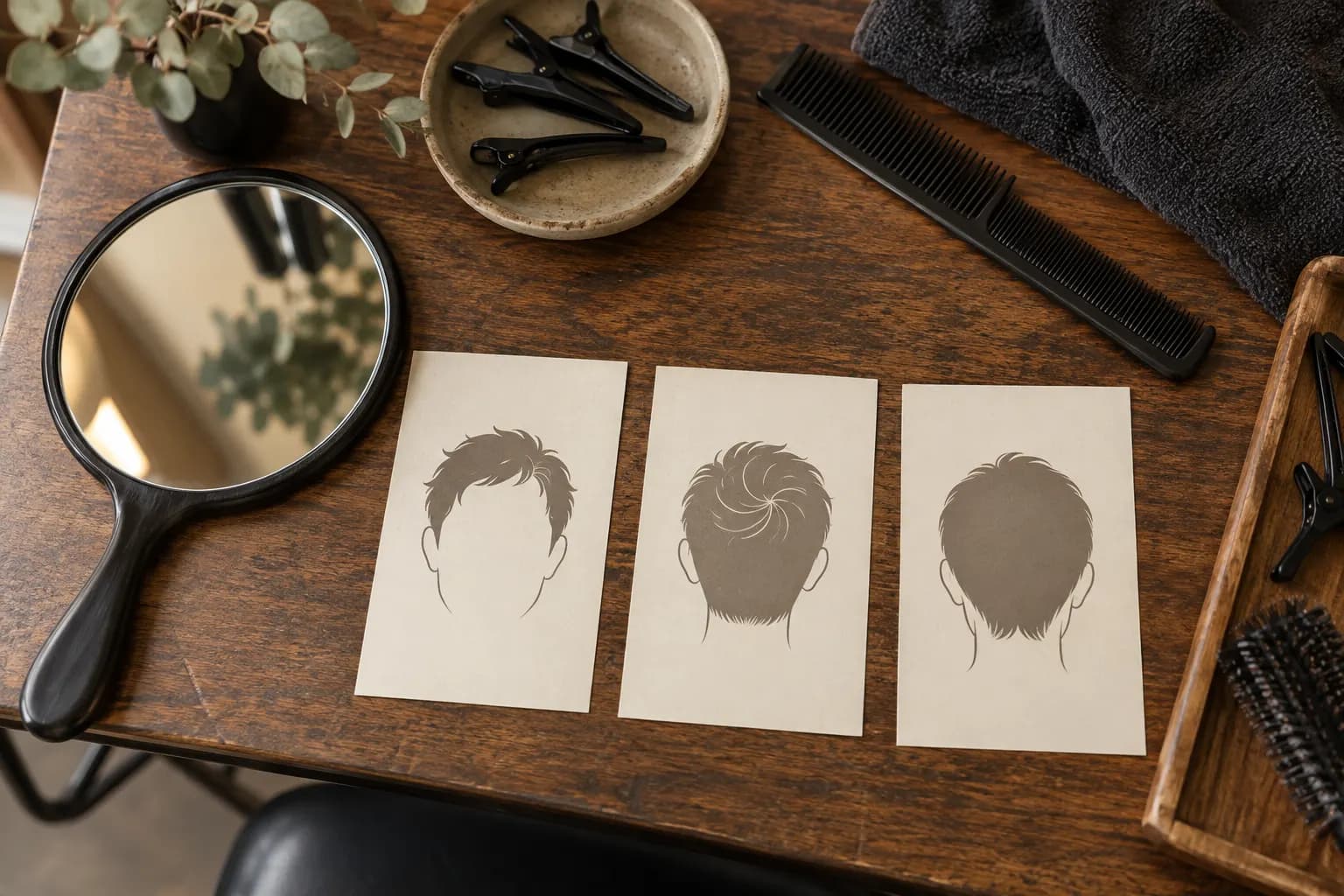
Use a preview to compare shape, never to predict a cowlick
Once you know the growth zones, a visual comparison becomes more useful. Start with a clear, ordinary photograph with your usual part and a view of the full hairline. In Hair Muse, compare one large decision at a time: open forehead versus fringe, longer top versus close crop, or a compact bob versus a textured outline. Keep the source photo fixed and save two or three options, not a gallery of tiny variations. Choose the option whose overall silhouette you would still like if the cowlick keeps its own direction. A preview is a planning image; it cannot simulate the angle of each follicle, a crown part after sleep or the way your nape grows.
HairChapter and Hair Muse have the same publisher. Hair Muse is free to download, while some uses or functions may require in-app purchases. Use it as a visual conversation aid, not an authority about what a stylist can cut or what your hair will do. Show the shortlist alongside the unstyled front, crown and back photographs. Label the elements you want from each image and explicitly mark the part that must be adapted to your growth pattern. A strong preview helps you say “this length and mood, but not this perfectly flat fringe.” That is much more useful than asking for the entire generated image.
- One unchanged source photograph
- Two or three clearly different shapes
- Natural part and dry hairline visible
- One sentence about what the preview cannot predict
Bring a cowlick-specific brief to the haircut
Try this: “The front rises on my right side after it dries. I like the length and open shape in this reference, but I do not want to blow-dry a straight fringe every day. Can we leave enough length to see how it falls before refining it?” For a crown issue, substitute the direction of the swirl and your preferred back view; for the nape, name the neckline that tends to lift. Tell the stylist how you wash, part, dry and wear the hair, not only which product you own. Ask them to check the planned shortest point while the hair is dry or after they have seen its natural behaviour.
Agree on two photographs of the finished cut: the styled look and a simple dry fall. Discuss what happens between appointments. If a short crown or sharp neckline must be tidied often to keep the design, that is an upkeep choice rather than a surprise. If you want flexibility, ask which longer edge can remain untouched and which detail can be adjusted later. A good result accommodates the cowlick without demanding a daily fight. The final test is your next ordinary morning, not only the salon chair.
- Location and direction of the pattern
- Preferred outline from each angle
- Maximum daily styling time
- Shortest section to check dry
- How the cut should grow out

Three terms that make this conversation clearer.
You do not need to prescribe technique. Use these words to describe the visible structure, name the behavior you want, and ask what your stylist would adapt.
Perimeter
The outside boundary of the haircut: the line you read around the bottom, sides, and overall edge. A compact perimeter usually feels fuller and more controlled, while a broken or highly layered perimeter can feel lighter, softer, or more textured.
SAY IT IN THE CHAIR“I like the movement, but I want the outside edge to remain substantial when the hair is straight or air-dried.”Open full definition
Layer map
A plain-language way to describe where the shortest layers begin, how quickly they connect to longer sections, and where movement or volume is intended to appear. Two haircuts with the same overall length can feel completely different because their layer maps differ.
SAY IT IN THE CHAIR“Show me the shortest layer, where it connects, and how much weight remains beneath it.”Open full definition
Silhouette
The complete outside shape a haircut creates when viewed as a whole: compact, rounded, triangular, elongated, wide, narrow, or deliberately irregular. It is often the most reliable feature to compare before discussing small details or a polished finish.
SAY IT IN THE CHAIR“I want this overall shape, but I am open to changing the internal technique for my hair.”Open full definition
Turn this guide into a decision.
Three honest answers are more useful than ten additional reference photos. Your responses stay on this page and can be changed at any time.
- 01Can you point to the exact structural detail you want from this cut?
Name the shortest point, outside line, layer map, or placement of volume.
- 02Have you named the boundary you do not want traded away?
Examples: tie-back length, full ends, an open forehead, dry length, or support for natural texture.
- 03Does the plan fit your real styling and maintenance rhythm?
Count ordinary mornings, fallback styles, trim frequency, and the way the shape is likely to grow.
The short answers.
What is the best haircut for a cowlick?
There is no universal cut. Find whether the pattern is at the front, crown or nape, then choose a length and outline that use or soften its natural direction. Have the stylist check the shortest section dry.
Can I have bangs if I have a front cowlick?
Often, but the fringe width, dry length, opening and daily styling need a realistic plan. Test the natural part first and consider a longer initial version rather than assuming a straight, short line will lie flat.
Should a crown cowlick be cut very short?
Not automatically. Depending on texture and density, very short hair may expose the swirl or make it part of a textured cut; more length may soften it. Ask to compare the dry result before deciding.
Can you train a cowlick to grow a different way?
Styling can redirect the visible hair temporarily, but a haircut or product does not change the direction in which it grows from the scalp. Choose the maintenance effort you are willing to repeat.
Can an AI hairstyle preview show my real cowlick?
No. It helps compare broad shapes and partings, not follicle direction, exact dry behaviour or salon feasibility. Bring real unstyled photographs of your front, crown and nape to the consultation.
How this guide was built.
HairChapter separates haircut structure from styling, trend names, and medical claims. Our recommendations are decision tools, not universal rules: a stylist should adapt the direction to your starting length, density, pattern, condition, growth habits, and normal routine.
We do not claim that a photograph or AI preview can predict a finished service. Sudden shedding, patchy loss, scalp pain, persistent irritation, or an unexplained change in density belongs with a qualified medical professional—not a haircut guide.
Sources for health-related statements
- Milady — Standard Cosmetology transition guide Professional haircutting education identifies growth pattern, density, texture and wave pattern as factors in how a cut behaves.
- Fellow Barber — using a cowlick to choose a part A barber’s first-hand explanation of working with, rather than automatically fighting, the direction of a crown or front cowlick.