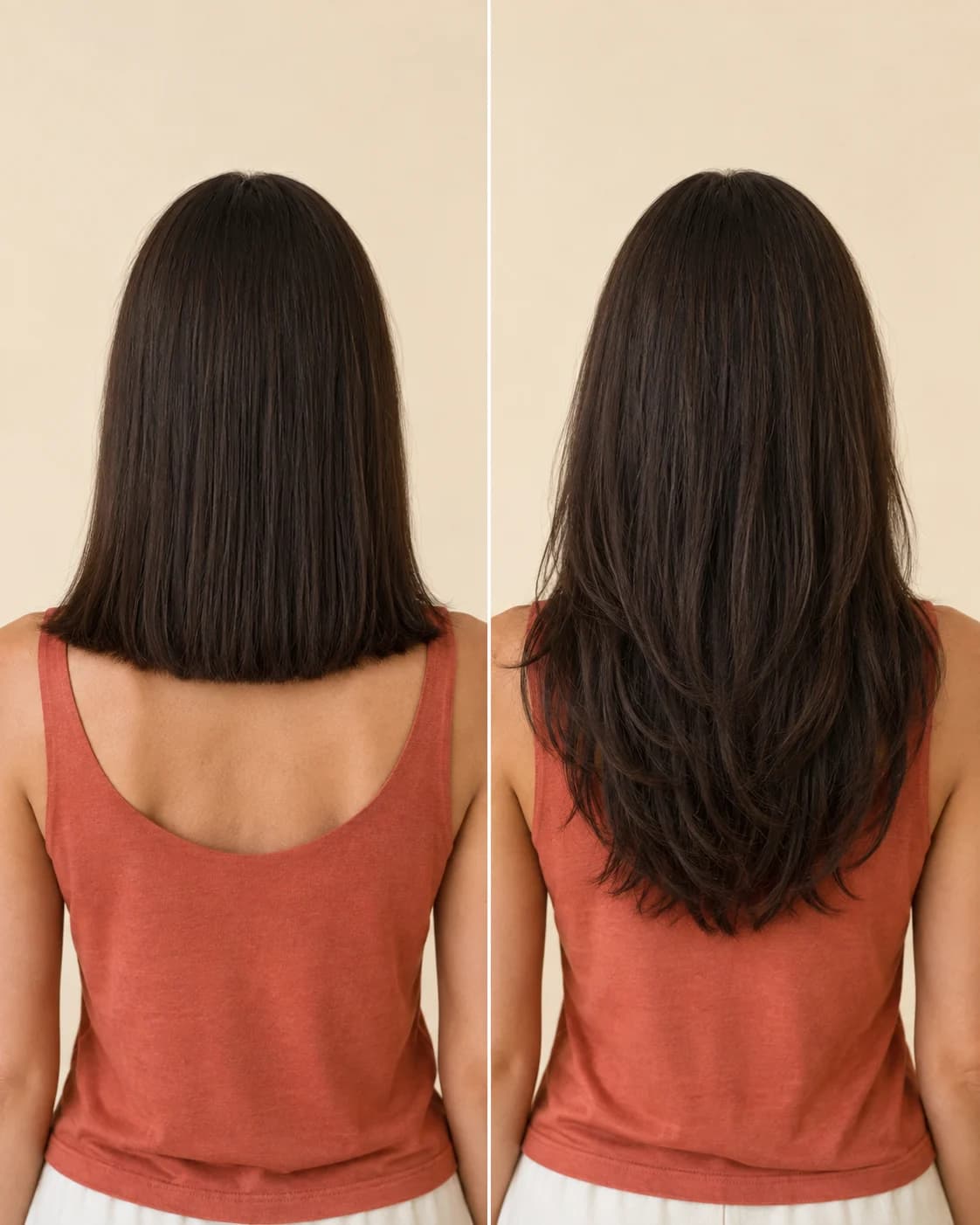
Understand what “blunt” really controls
A blunt cut describes a strong, relatively uniform perimeter. It does not require every strand on the head to be one length, and it can still include subtle internal work or face framing. Its defining feature is that the outside edge reads as complete.
That strong edge can make fine or lower-density ends appear more substantial. On very dense hair, the same line may feel heavy unless the interior is shaped carefully. Ask about the relationship between the visible perimeter and any hidden weight removal.
Understand what layers actually redistribute
Layers shorten selected areas so the hair moves, stacks, expands, or releases weight. Their effect depends on where they begin, how much they contrast with the longest length, and whether they are visible or blended. “Layered” alone says almost nothing about the finished shape.
Long layers can preserve a calm outline while adding movement through the lower lengths. Short layers near the crown create lift and a more obvious silhouette. Face-framing layers change the front while leaving much of the back untouched.
Match the decision to density
If the ends feel thin, the first priority may be rebuilding a stronger baseline before adding more short pieces. If the hair is dense and triangular, preserving every strand at the perimeter may concentrate too much weight. The useful answer is often not blunt or layered, but how much of each.
Ask the stylist to show where density can be removed without making the outside line look sparse. Judge the plan on dry hair and look at the sides as well as the back; those are common places for over-layering to reveal itself.
Hybrid brief: “I want movement internally, but I still want the bottom edge to look complete when the hair is straight.”

Let natural pattern influence the outline
Straight hair displays a blunt line clearly. Waves can soften it and may need selective layers to avoid a heavy triangle. Curls and coils often require a silhouette plan across several dry zones rather than a single baseline decision. Pattern changes how the same cutting idea appears.
Bring references with a texture and finish close to yours. A layered cut shown in a curled blowout may appear fuller and more uniform than it does when air-dried. Ask what the structure looks like without the styling effect.
Compare the maintenance honestly
A sharp blunt bob may be simple to style but show growth quickly. Long blended layers may tolerate a longer calendar interval but need heat or product to reveal the intended movement. Maintenance lives in both the salon schedule and the morning routine.
Consider the fallback styles too. Shorter layers may escape a ponytail; a one-length shape may feel heavier on day three. Decide which inconvenience matters more in your real week.
Use a three-view comparison
Compare the two directions from the front, profile, and back. The front reveals framing, the side shows weight distribution, and the back shows whether the perimeter feels solid or mobile. One flattering angle is not enough evidence for a structural decision.
If you are undecided, preserve the perimeter and add the least aggressive layer map that creates useful movement. Live with the result through several wash days before deciding whether to increase the contrast.
Three terms that make this conversation clearer.
You do not need to prescribe technique. Use these words to describe the visible structure, name the behavior you want, and ask what your stylist would adapt.
Baseline
The lower edge or foundation of a haircut, especially visible in bobs and other compact shapes. A strong baseline can make the ends read as fuller and more graphic; a softer or broken baseline can make the outline feel lighter and less exact.
SAY IT IN THE CHAIR“I want the bottom line to feel complete, but not so sharp that the grow-out looks abrupt.”Open full definition
Elevation
A technical idea describing how hair is lifted away from its natural fall while a shape is created. Different elevation choices can influence graduation, layering, and weight, but clients do not need to prescribe an angle; the useful conversation is about the visible result.
SAY IT IN THE CHAIR“I want movement here while keeping the bottom visually full—what layer plan supports that?”Open full definition
Perimeter
The outside boundary of the haircut: the line you read around the bottom, sides, and overall edge. A compact perimeter usually feels fuller and more controlled, while a broken or highly layered perimeter can feel lighter, softer, or more textured.
SAY IT IN THE CHAIR“I like the movement, but I want the outside edge to remain substantial when the hair is straight or air-dried.”Open full definition
Turn this guide into a decision.
Three honest answers are more useful than ten additional reference photos. Your responses stay on this page and can be changed at any time.
- 01Can you point to the exact structural detail you want from this cut?
Name the shortest point, outside line, layer map, or placement of volume.
- 02Have you named the boundary you do not want traded away?
Examples: tie-back length, full ends, an open forehead, dry length, or support for natural texture.
- 03Does the plan fit your real styling and maintenance rhythm?
Count ordinary mornings, fallback styles, trim frequency, and the way the shape is likely to grow.
The short answers.
Does a blunt cut make hair look thicker?
A strong perimeter can make the ends appear fuller, especially on fine or lower-density hair. Overall fullness still depends on length, condition, density, and styling.
Can I have layers and blunt ends?
Yes. A stylist can preserve a strong outside line while adding long, subtle, or internal layers to redistribute weight and movement.
How this guide was built.
HairChapter separates haircut structure from styling, trend names, and medical claims. Our recommendations are decision tools, not universal rules: a stylist should adapt the direction to your starting length, density, pattern, condition, growth habits, and normal routine.
We do not claim that a photograph or AI preview can predict a finished service. Sudden shedding, patchy loss, scalp pain, persistent irritation, or an unexplained change in density belongs with a qualified medical professional—not a haircut guide.