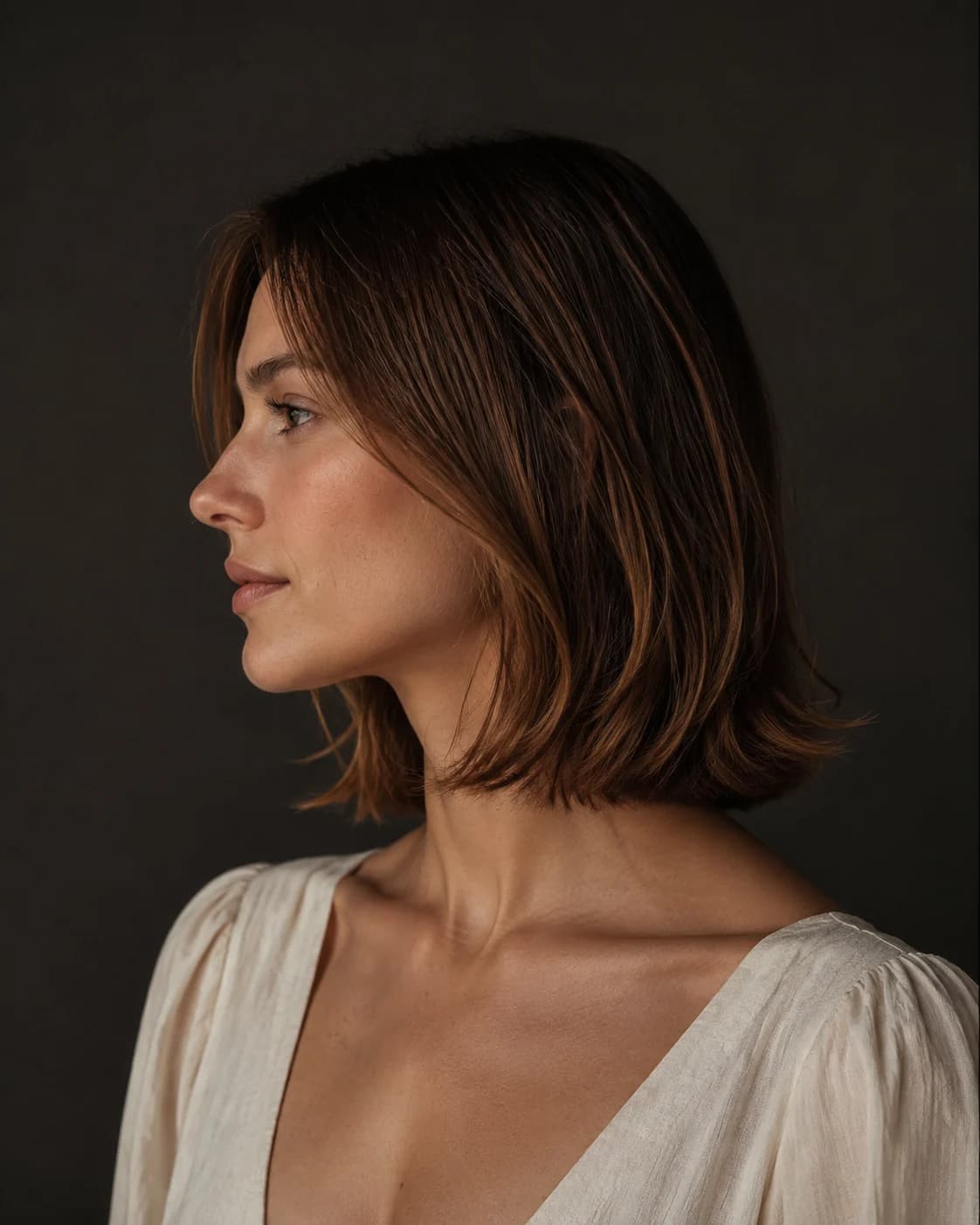
What changes above the shoulder
A bob creates a clearer visual statement and removes more old length, but it may expose growth patterns at the nape and reduce tie-back options. Precise versions can also show growth sooner.
Short does not always mean faster. Depending on texture, a bob may need deliberate drying to sit in the intended line.
Why the lob is a useful middle ground
A lob usually lands between the shoulders and collarbone. It keeps enough length for more styling options while still changing the silhouette. It can be a lower-risk transition from long hair.
The exact landing point matters. Hair that flips on the shoulder may behave differently from hair that ends just above or below it.
Make the decision with four tests
Compare the two lengths using the situations that happen in your week, not only a front-facing photo.
- Can it tie back for work or exercise?
- Will your natural texture shrink above the planned line?
- How often can you reshape the perimeter?
- Do you want a dramatic change or flexible transition?

Test the landing point around the shoulders
The difference between a bob and lob is not only a number of inches. Ends that stop above the shoulder can swing freely; ends that meet the shoulder may flip, compress, or change direction; ends below it gain more weight and tie-back potential. Clothing, neck length, posture, and natural bend all change how that line appears.
During the consultation, fold or clip the hair at several possible lengths and view it from the side. For curls and waves, allow for the dry position. Choose the landing point for its behavior first and its category name second.
Specify the geometry, not just “bob”
A one-length bob, softly graduated bob, rounded bob, textured bob, and angled bob can share a similar overall length while creating different weight and maintenance. Decide whether the perimeter should feel sharp or soft, whether the back should stack, and whether the front should match or extend beyond it.
Ask what the cut will look like tucked, air-dried, and several weeks into growth. If you want a strong graphic line, accept that reshaping may matter sooner. If you want a forgiving grow-out, keep the geometry quieter and the transition between lengths less extreme.
Better than “I want a lob”: “I want a collarbone line, no stacked back, enough softness to air-dry, and enough length for a low tie.”
Three terms that make this conversation clearer.
You do not need to prescribe technique. Use these words to describe the visible structure, name the behavior you want, and ask what your stylist would adapt.
Bob
A short-to-medium haircut whose perimeter commonly lands between the ear and jaw or lower neck. The name does not specify one technique: a bob can be blunt, graduated, layered, rounded, angled, sleek, textured, or adapted to curls and coils.
SAY IT IN THE CHAIR“The dry landing point I like is here; how should the perimeter and internal shape change for my texture?”Open full definition
Graduation
A progressive build-up of weight created through shorter lengths beneath longer ones. Graduation can support a rounded bob, control the nape, or create a fuller-looking shape, but the amount and placement should respond to texture, density, and the desired outline.
SAY IT IN THE CHAIR“I like the fullness in this shape—where is it built, and will that placement work with my natural texture?”Open full definition
Lob
A long bob, usually sitting somewhere between the lower neck and collarbone. The category is broad: a lob can clear the shoulders, touch them, or rest on them, and that landing point can change movement, tie-back ability, and how the ends turn.
SAY IT IN THE CHAIR“I want a lob that still ties back; where must the front and perimeter land when dry?”Open full definition
Turn this guide into a decision.
Three honest answers are more useful than ten additional reference photos. Your responses stay on this page and can be changed at any time.
- 01Can you point to the exact structural detail you want from this cut?
Name the shortest point, outside line, layer map, or placement of volume.
- 02Have you named the boundary you do not want traded away?
Examples: tie-back length, full ends, an open forehead, dry length, or support for natural texture.
- 03Does the plan fit your real styling and maintenance rhythm?
Count ordinary mornings, fallback styles, trim frequency, and the way the shape is likely to grow.
The short answers.
Is a lob easier to maintain than a bob?
Often, because it retains tie-back options and can have a softer grow-out. A simple bob may still be easy when it works with your texture.
Where should a lob end?
The collarbone is a common reference, but the best point depends on shoulder width, shrinkage, texture, and where the hair naturally bends.
How this guide was built.
HairChapter separates haircut structure from styling, trend names, and medical claims. Our recommendations are decision tools, not universal rules: a stylist should adapt the direction to your starting length, density, pattern, condition, growth habits, and normal routine.
We do not claim that a photograph or AI preview can predict a finished service. Sudden shedding, patchy loss, scalp pain, persistent irritation, or an unexplained change in density belongs with a qualified medical professional—not a haircut guide.