
Dry cut vs wet cut: start with the result, not a rule
A dry cut vs wet cut decision is really two questions. First, what structure must the stylist create: a sharp perimeter, balanced layers, a fringe, a short taper or a curl-by-curl shape? Second, what must be visible before the appointment ends: the true dry length, the way a wave bends, the position of a cowlick or the outline without a blowout? A wet cut works in controlled, combed sections. A dry cut works with hair in its dry state, either before washing or after drying. Many useful haircuts include both stages. The label on the booking page is less informative than the actual sequence.
A smooth, wet baseline can be followed by a dry refinement; a curl specialist may begin with dry, normally worn hair and still wash or reshape later. Ask the stylist what the method lets them see and what it temporarily hides.
The useful question is not “Which method is best?” but “When will we see the finished shape in my normal texture?”
Name the line and the movement before the appointment
Describe the cut from the bottom up. Do you want a compact, even edge, a soft perimeter, a defined angle, or ends that move separately? Then name the shortest front piece and the part of the hair that needs room to bend. Neither “dry cut” nor “wet cut” alone tells the stylist how the final layers should behave.
Bring one photograph of your own hair after a normal wash and one or two references showing specific details. Mark the edge you want to keep and the part that must not become shorter. Hair.com’s stylist interview explains that wet cutting can help establish clean lines while dry cutting exposes how hair actually settles. Jean Louis David similarly describes the choice as conditional rather than absolute. Use those distinctions to make a brief: “I want a clean shoulder line, but please check the front dry because it flips outward.” If your cut has several goals, give them a priority order before the first section is made.
- Desired perimeter and shortest piece
- Natural texture and everyday finish
- The detail that needs controlled precision
- The detail that must be checked dry
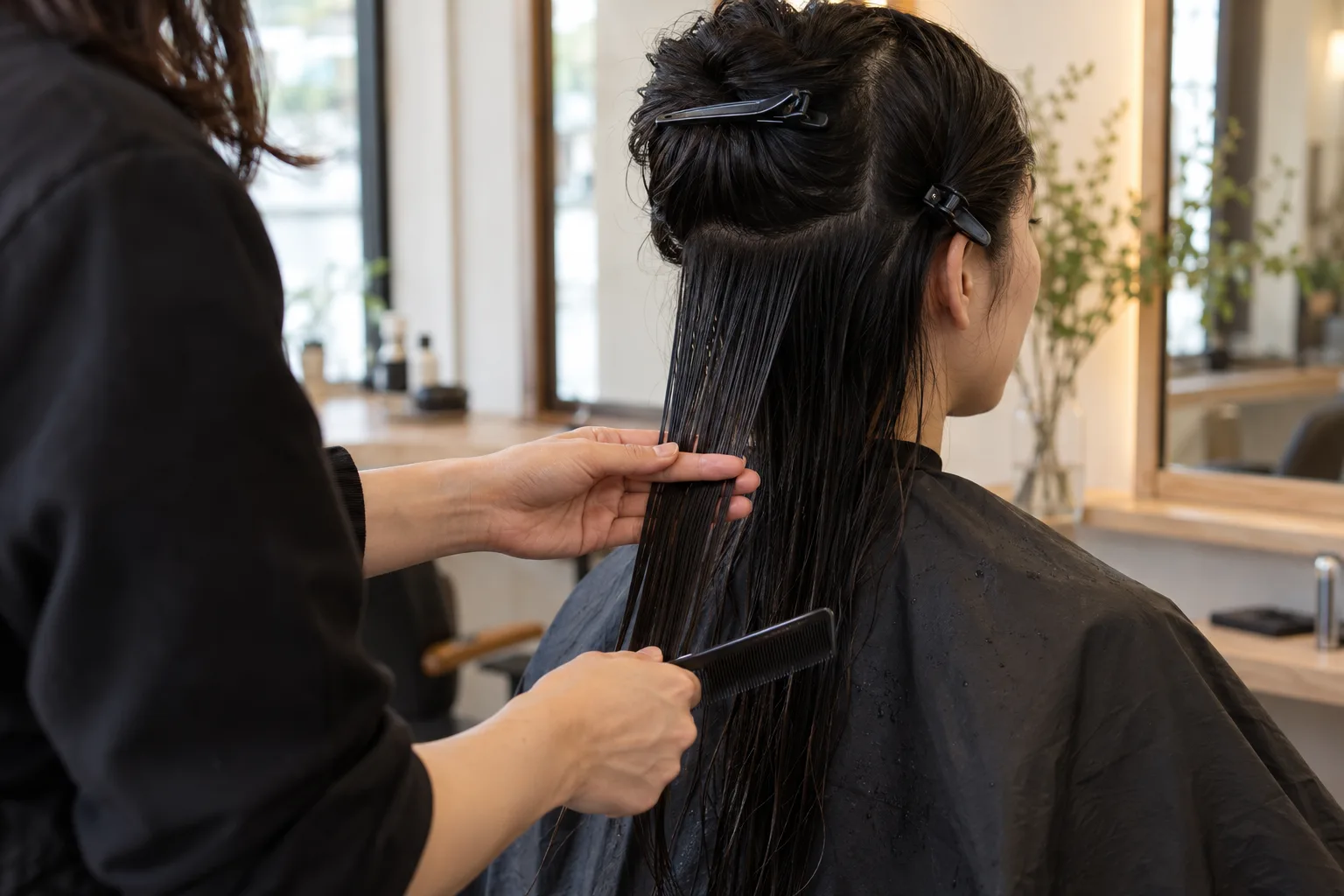
What a wet cut can do particularly well
Damp hair can be combed into consistent sections and held at a chosen angle. That makes it useful for constructing a strong baseline, a geometric bob, an even long perimeter or a deliberate graduated shape. The stylist can compare section to section while the hair is controlled. If your goal is a crisp line, this can be a sensible first stage. It does not mean every strand will land at exactly that visible length after drying. Wet hair may stretch, lie flatter or show a different bend from your ordinary finish, especially when waves and curls are pulled straight.
Ask where the initial line is being set and how much length is being left for the dry check. A stylist may cut conservatively wet, dry the hair in a finish close to yours and then adjust the front, ends or weight. That can be the planned second half of the service. If you air-dry a lot of movement into it, the dry stage becomes more important. Confirm the service and preparation with the salon rather than arriving with dripping or heavily styled hair.
What a dry cut can reveal before you lose length
Dry hair shows the line that you and other people will actually see. A wave can bend above the shoulder, a curl can spring into a shorter visible position, and a crown can separate along a natural growth direction. When those details drive the haircut, seeing them before shortening the hair can help. A dry cut may be the main method for a curl-by-curl shape, or it may be a short finishing pass after a wet foundation. The latter is especially useful when the back seems even in controlled sections but one front piece lands differently after drying.
Dry is not automatically more precise in every sense. A deliberately straight, graphic edge can be harder to build through hair that is already moving in several directions. Product buildup, a temporary heat-set style or yesterday’s ponytail mark can also misrepresent the way the hair normally lies. If the salon asks you to arrive with clean, fully dry hair worn in its usual pattern, follow those instructions. If they intend to wash and dry before the refinement, ask whether the styling will resemble your home routine. The goal is truthful information, not a ritual that earns the label “dry cut.”

For curls and coils, agree on the dry landing point
The visible length of a curl or coil can change substantially between wet, stretched and dry states, but there is no single shrinkage percentage that applies to every head. Different sections on the same person can spring back differently. If you wear your hair naturally most days, show the stylist that version and point to the dry length you want at the front, sides and back. A dry assessment or a dry cutting stage can protect that agreement. Wet sectioning may still be useful for some shapes or for a person who often stretches their hair; a specialist should explain how the plan accounts for both states.
Do not accept a blanket “curly hair must always be cut dry” or “wet cutting is more professional.” The real question is whether the stylist can predict, inspect and adjust the result in the finish you wear. Ask how they will handle sections with different curl patterns, where they will leave weight and how the silhouette will look after a home wash. If a promised cut is shown only in an elongated blowout, ask to see it in the natural state before deciding the shortest length. If you frequently alternate stretched and natural finishes, say which one takes priority; one cut may not create identical outlines in both.
Fringes, short cuts and mixed methods need a final check
A fringe is a small area with a large visual effect. Even if the stylist establishes its section wet, agree on the dry position before cutting it short. The roots may lift, the front may split and a wave may pull the line upward. A conservative first length gives room for refinement, but it is not a guarantee that a fringe will lie flat. Short cuts have their own checks: crown growth, ear clearance and neckline direction can change the outline once the hair is dry. Clipper work and scissor work also bring different controls, so the appointment may not fit neatly into one “wet” or “dry” label.
A mixed sequence is often the most useful answer: assess the natural dry fall, establish a controlled shape, then inspect and refine the dry result. The order may reverse depending on the stylist and service. Ask what will happen at each stage rather than prescribing a technique you cannot see. If you want a sharp bob and also have a wave at one temple, mention both. A stylist can aim for the clean edge while allowing a deliberate adjustment where the wave changes the visible line. The trade-off is sometimes a slightly less mathematical perimeter in exchange for a more convincing ordinary-day haircut.

Use a short salon script and protect your priorities
Try this wording: “I wear my hair air-dried most days. I want the back to sit at the collarbone and the front to stay long enough to tuck behind my ears. Would you build the edge wet, dry, or use both? Please show me the dry landing point before you shorten the front.” Replace the landmarks with your own. Tell the stylist if your hair is usually straightened, stretched, diffused or tied back. Point to any area that springs up or lies differently after sleep. Ask whether the advertised dry cut includes a wash and finish, because service names and booking times vary.
A visual preview can help you settle one broad question before this conversation: compact edge or loose outline, open forehead or fringe, shorter or longer overall silhouette. Hair Muse can show those alternatives on the same photo, but it cannot model your real shrinkage, cutting precision or the stylist’s technique. HairChapter and Hair Muse have the same publisher. Hair Muse is free to download; some use or features may involve in-app purchases. Take only two or three saved shapes and pair them with an unstyled photograph of your actual hair. The stylist needs the real texture as much as the image of the goal.
- One priority for the final outline
- One firm length boundary
- Your normal drying or styling method
- A dry check before the cut is declared finished
Judge the result after the salon finish, not only in it
Before leaving, look at the perimeter from the front, side and back. Move your hair into its normal part and ask to see the shortest pieces without the brush holding them in place. If you plan to air-dry at home, ask which step in the salon finish was essential and which was cosmetic. Take a quick reference photograph. Then judge the cut after your own wash and usual drying routine, when the hair is no longer arranged to demonstrate the stylist’s work. A small change in fall is normal; a fundamental mismatch between the agreed dry length and your ordinary result is worth raising with the salon promptly.
This is a way to discuss a professional process, especially when texture or a clear edge makes the method matter. Neither a dry cut nor a wet cut makes split ends disappear permanently, changes natural growth direction or guarantees an exact reference image. A good outcome is a shape whose controlled construction and natural behaviour both make sense for your life. Explain the desired line, dry landing point and finish you will actually repeat.

Three terms that make this conversation clearer.
You do not need to prescribe technique. Use these words to describe the visible structure, name the behavior you want, and ask what your stylist would adapt.
Consultation brief
A short, usable description of the result you want and the reality it must support. The strongest brief combines one structural change, one non-negotiable boundary, your normal styling routine, and a question that invites the stylist to adapt the plan.
SAY IT IN THE CHAIR“I want to change this, keep this boundary, and make sure the result still works when I style it this way.”Open full definition
Baseline
The lower edge or foundation of a haircut, especially visible in bobs and other compact shapes. A strong baseline can make the ends read as fuller and more graphic; a softer or broken baseline can make the outline feel lighter and less exact.
SAY IT IN THE CHAIR“I want the bottom line to feel complete, but not so sharp that the grow-out looks abrupt.”Open full definition
Maintenance window
The period during which a haircut still performs the job it was designed to do before a particular detail needs reshaping. The true window is set by the first meaningful change—often a fringe, nape, perimeter, crown, or loss of internal balance.
SAY IT IN THE CHAIR“Which detail will stop working first, and what is a realistic return window for that part?”Open full definition
Turn this guide into a decision.
Three honest answers are more useful than ten additional reference photos. Your responses stay on this page and can be changed at any time.
- 01Can you state one clear priority for this appointment?
A useful priority is specific enough to protect when the reference needs adaptation.
- 02Have you named the boundary you do not want traded away?
Examples: tie-back length, full ends, an open forehead, dry length, or support for natural texture.
- 03Does the plan fit your real styling and maintenance rhythm?
Count ordinary mornings, fallback styles, trim frequency, and the way the shape is likely to grow.
The short answers.
Is a dry cut better than a wet cut?
Not universally. Dry cutting lets a stylist see natural fall and visible length; wet cutting helps control sections and build precise lines. The desired shape and your usual finish determine the useful sequence.
Should curly hair always be cut dry?
A dry assessment is especially valuable when you wear curls or coils naturally, because their visible length can change when wet or stretched. Some specialists still combine wet and dry stages. Ask how the final dry shape will be checked.
Will a wet cut make my hair look shorter?
Hair can settle differently after drying, particularly if it waves or curls. Agree on the finished dry landing point and ask the stylist to allow for that movement rather than relying only on the wet measurement.
Can I request both methods in one appointment?
Yes, if the booked service and stylist allow it. A controlled wet foundation followed by a dry check is common, but the order and extent depend on the cut. Ask the salon how it works before booking.
How should I arrive for a dry cut?
Follow the salon’s instructions. Usually the stylist needs clean, fully dry hair in a texture close to how you wear it, without heavy product or a temporary set that conceals its normal fall.
How this guide was built.
HairChapter separates haircut structure from styling, trend names, and medical claims. Our recommendations are decision tools, not universal rules: a stylist should adapt the direction to your starting length, density, pattern, condition, growth habits, and normal routine.
We do not claim that a photograph or AI preview can predict a finished service. Sudden shedding, patchy loss, scalp pain, persistent irritation, or an unexplained change in density belongs with a qualified medical professional—not a haircut guide.
Sources for health-related statements
- Hair.com by L’Oréal — wet versus dry cutting Stylist interview explains precision, visible natural fall and why a combined cut can be useful.
- Jean Louis David — corte en seco y en mojado Salon explanation compares controlled wet cutting with observing real movement and notes that neither method is always best.