
Map the weight by area
Dense hair may feel heavy above the ears, through the crown, at the front, or across the top without behaving the same way in each place. Identify where it expands, where it collapses, and where you still want a strong outline. The answer should be more specific than thick everywhere.
Show the barber how the hair sits without a hat, strong product, or a fresh blow-dry. Growth patterns and natural bend help determine whether shorter pieces will lie down, lift, or create more width than the longer weight did.
Choose silhouette before removal technique
Decide whether you want a compact shape, visible texture, height through the top, or a softer profile. Weight removal should support that silhouette. Reducing hair everywhere can leave the cut difficult to control without creating a clear visual direction.
Bring references with a comparable amount and behavior of hair when possible. If the model has finer or straighter hair, use the image for proportion and explain that the finish must be adapted rather than copied.
Better request: “Reduce the width above the ears, keep enough weight at the front to control the lift, and preserve a full top outline.”
Use the side transition to control width
A very short side can create strong contrast with a dense top. That may be the intended look, but it can also produce a ledge as the sides grow. A longer taper, scissor work, or a lower transition may connect the two areas more gradually.
Ask where the widest point of the finished shape should sit. The answer helps determine whether weight should remain at the temples, be controlled above the ears, or move upward into the top. Clipper numbers alone do not describe that relationship.
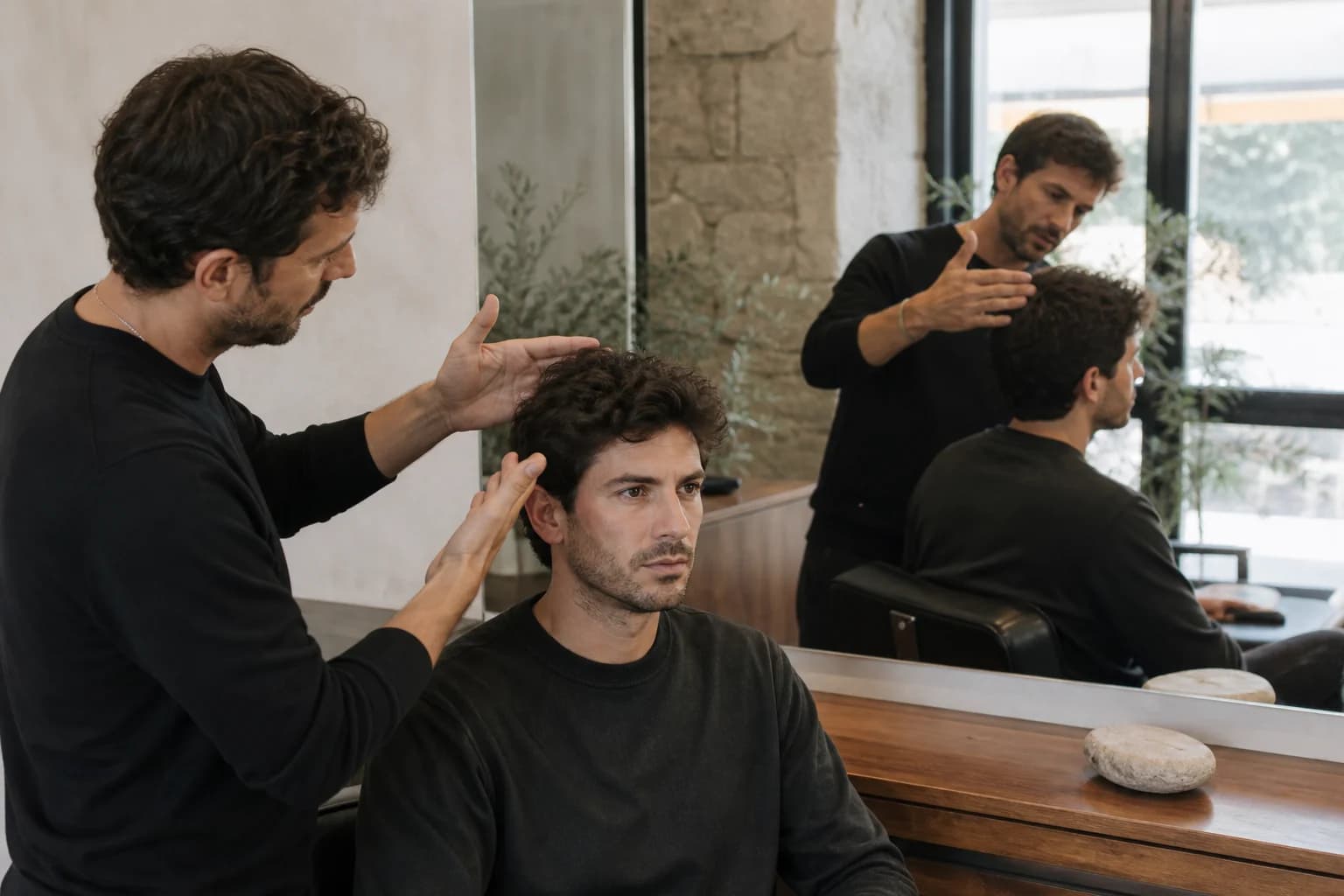
Protect control at the crown and front
The crown and front hairline often have strong direction. Cutting them very short may make them stand; leaving them too long may create heaviness that falls into the wrong place. The useful length is the one that works with the direction you normally wear.
Describe whether the top is worn forward, back, parted, curled, or left natural. Ask the barber to check the shape both with and without product before final refinements. A wet finish can hide the width or lift that returns when dense hair dries.
Make texture serve the shape
Texture can create separation and reduce a solid appearance, but more texturizing does not automatically mean easier hair. Short internal pieces may expand, feel rough, or require product to sit with the longer surface. Technique and placement matter more than the general instruction to thin it out.
Ask how the removal will affect the cut after several weeks. A method that feels light on the first day should also grow without disconnected short sections becoming the new source of bulk.
Plan the next six weeks
Dense short hair can change quickly as the sides fill, the crown gains height, and the top loses separation. Ask which area will become noticeable first and whether a small cleanup or a complete reshape will be needed at the next visit.
Record the part that grew well and the part that became difficult. At the following appointment, request a targeted adjustment instead of simply repeating the same amount removed everywhere. Each grow-out becomes useful information for the next version.
Three terms that make this conversation clearer.
You do not need to prescribe technique. Use these words to describe the visible structure, name the behavior you want, and ask what your stylist would adapt.
Silhouette
The complete outside shape a haircut creates when viewed as a whole: compact, rounded, triangular, elongated, wide, narrow, or deliberately irregular. It is often the most reliable feature to compare before discussing small details or a polished finish.
SAY IT IN THE CHAIR“I want this overall shape, but I am open to changing the internal technique for my hair.”Open full definition
Growth pattern
The direction hair naturally leaves the scalp and moves through areas such as the front hairline, crown, nape, and around the ears. Cowlicks, whorls, and directional changes can alter how short sections lift, split, or settle.
SAY IT IN THE CHAIR“Can we look at the front and crown dry before choosing the shortest length?”Open full definition
Internal weight
The mass and density held inside the visible outline of a haircut. Thoughtful internal removal can make dense hair move or sit closer without automatically weakening the perimeter; poor placement can create short pieces, expansion, or transparent ends.
SAY IT IN THE CHAIR“Where will you remove weight, and which parts of the outline will stay visually solid?”Open full definition
Turn this guide into a decision.
Three honest answers are more useful than ten additional reference photos. Your responses stay on this page and can be changed at any time.
- 01Can you separate the top, transition, sides, and outline in your request?
A haircut name alone rarely explains how those four zones should connect or grow out.
- 02Have you named the boundary you do not want traded away?
Examples: tie-back length, full ends, an open forehead, dry length, or support for natural texture.
- 03Does the plan fit your real styling and maintenance rhythm?
Count ordinary mornings, fallback styles, trim frequency, and the way the shape is likely to grow.
The short answers.
Should thick men’s hair always be thinned out?
No. Weight removal should solve a specific problem in a specific area. The wrong placement can create expansion, short pieces, or a weak outline.
Are short sides easier with thick hair?
They can reduce immediate bulk, but they may create strong contrast and show regrowth quickly. A softer transition can be easier when longer appointment intervals matter.
How this guide was built.
HairChapter separates haircut structure from styling, trend names, and medical claims. Our recommendations are decision tools, not universal rules: a stylist should adapt the direction to your starting length, density, pattern, condition, growth habits, and normal routine.
We do not claim that a photograph or AI preview can predict a finished service. Sudden shedding, patchy loss, scalp pain, persistent irritation, or an unexplained change in density belongs with a qualified medical professional—not a haircut guide.