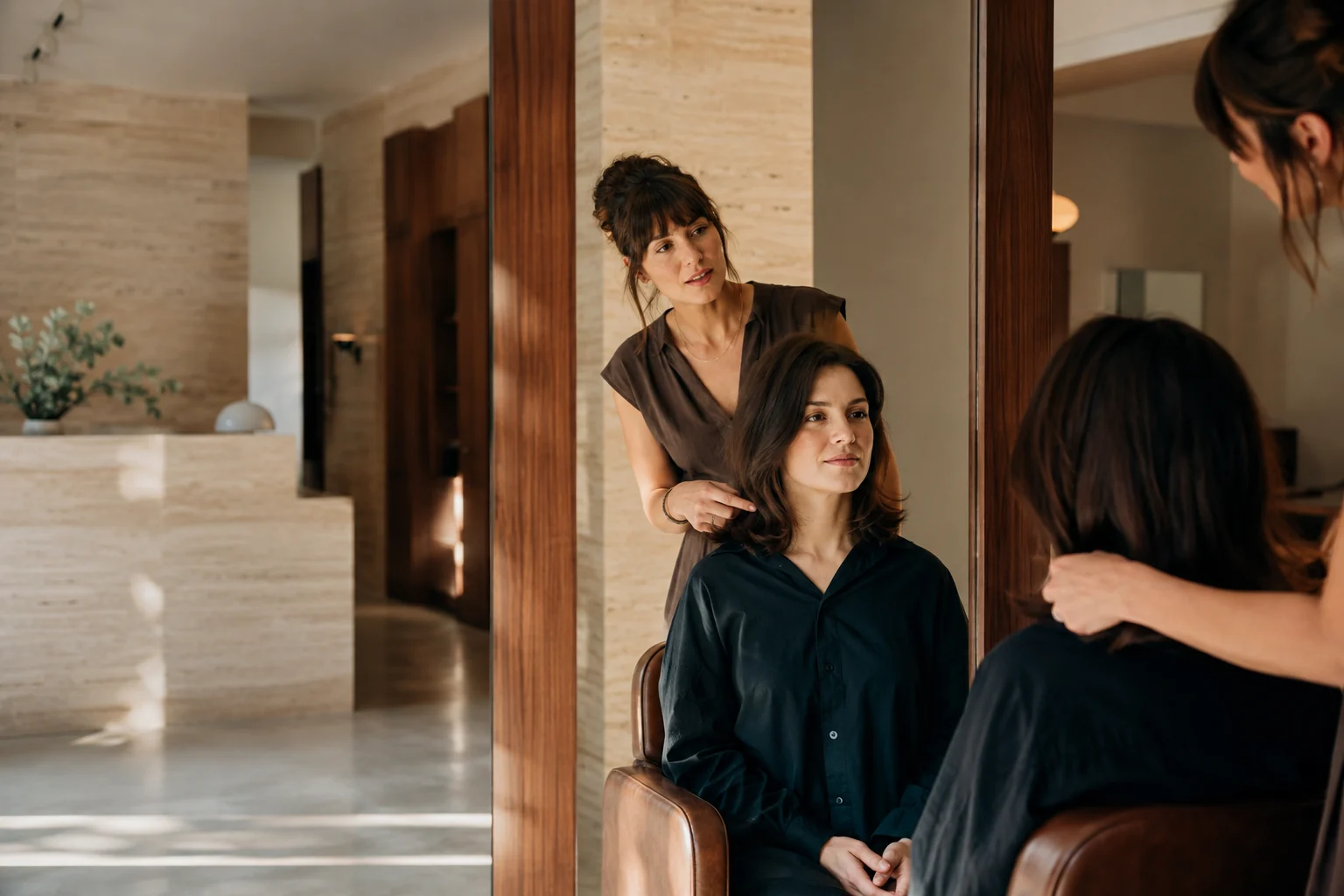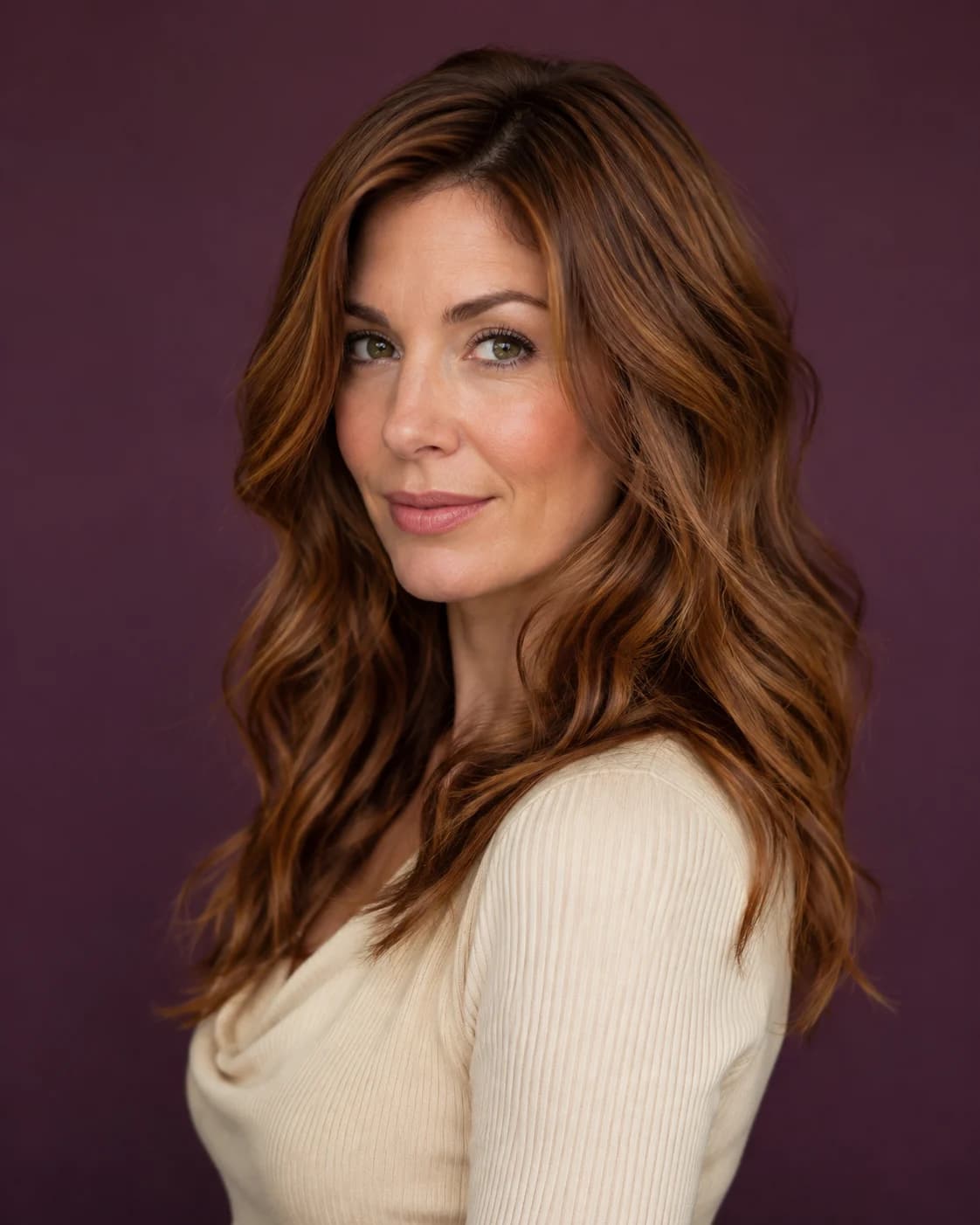
Haircuts with glasses work when three zones agree
Start with three zones: the brow line, the temple-and-ear area, and the face-framing pieces you handle all day. Frames already create a strong line across the upper face. A fringe can echo that line, soften it or crowd it. The arms of the glasses need a clear route to the ears. Short pieces must either sit comfortably above them, fall cleanly outside them or be long enough to tuck without springing forward.
There is no face-shape formula that names one correct haircut for every pair of glasses. Instead, decide what should lead. Bold frames can remain the focal point while the haircut supplies calmer movement; quiet frames can sit inside a stronger fringe or graphic bob. Test the relationship in your normal glasses, not a special pair worn only for photographs. The best result is the one you can wear, adjust and restyle without constantly separating hair from the hinges.
Treat your glasses as part of the daily brief: visible, physical and changed less often than your styling finish.
Map the frames before discussing length
Put on the glasses you wear most. Note where the top rim crosses your eyebrows, how wide the frame is at the temples, where the arms touch and whether the lower rim reaches the cheek when you smile. Those facts matter more than a generic label such as round or square. A wide frame plus very wide cheek-level volume can feel expansive; a narrow frame beside a severe curtain of hair may disappear. Neither is automatically wrong, but the choice should be deliberate.
Then look at the haircut without the glasses. It should still have a coherent outline because you may remove the frames, switch pairs or wear sunglasses. Ask your stylist to assess you both ways and to mark the shortest dry pieces while the glasses are on. If the frames slip, pinch or sit unevenly, solve that with an optician. A haircut can reveal or clear the frame, but it cannot correct poor optical fit.
- Top rim and brow line
- Frame width at the temples
- Arm position above the ears
- Cheek contact when smiling
- Hair shape with frames removed
Choose bangs with glasses by testing movement, not a still photo
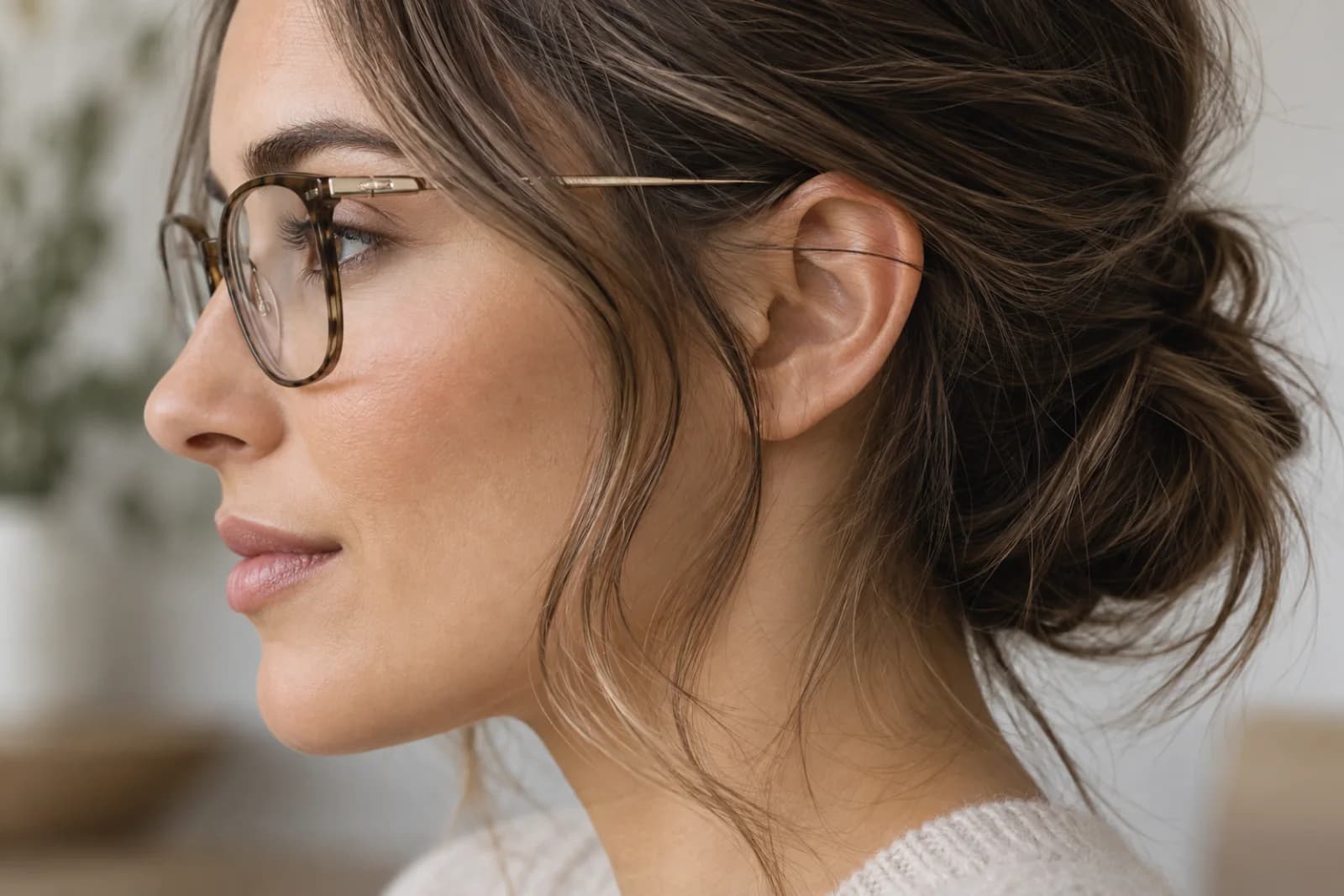
Bangs with glasses succeed when they have somewhere to go. A short fringe can sit clearly above the rim; a soft brow-length fringe can skim the frame; longer curtain pieces can open around it. The difficult zone is a dense length that repeatedly drops between the lens and the eye or catches behind the hinges. Humidity, cowlicks and shrinkage can move the landing point, so judge the fringe dry and in the texture you normally wear.
Before committing, imitate the proposed line by pinning the front section and moving through ordinary actions: look down, turn your head, push the glasses up and tuck your hair. Decide how much daily styling you accept. A precise micro fringe may clear the frame beautifully but demand frequent trims; a longer curtain fringe offers flexibility but may need heat or product to stay open. Ask for the lowest-maintenance version of the effect rather than copying the photograph literally.
Design face-framing layers around the temple-and-ear zone
Face-framing layers with glasses need a deliberate route. Pieces ending beside the widest part of a frame add activity to an already busy area. That can be expressive, but if you want calm, place the shortest meaningful piece above the frame or below the hinge and cheekbone zone. Ask what happens when the hair is tucked: does the section stay behind the ear, split around the arm or spring back across the lens?
Density changes the answer. Fine hair can lose too much perimeter if many short sections are carved around the face. Dense hair may need internal weight control so a tuck does not create a bulky shelf behind the ear. Curly and coily hair must be mapped at its dry resting length, with room for shrinkage and day-to-day variation. The aim is not to flatten texture around the glasses; it is to give each curl or layer a useful place to land.
Pick a length for your routine, not for a frame stereotype
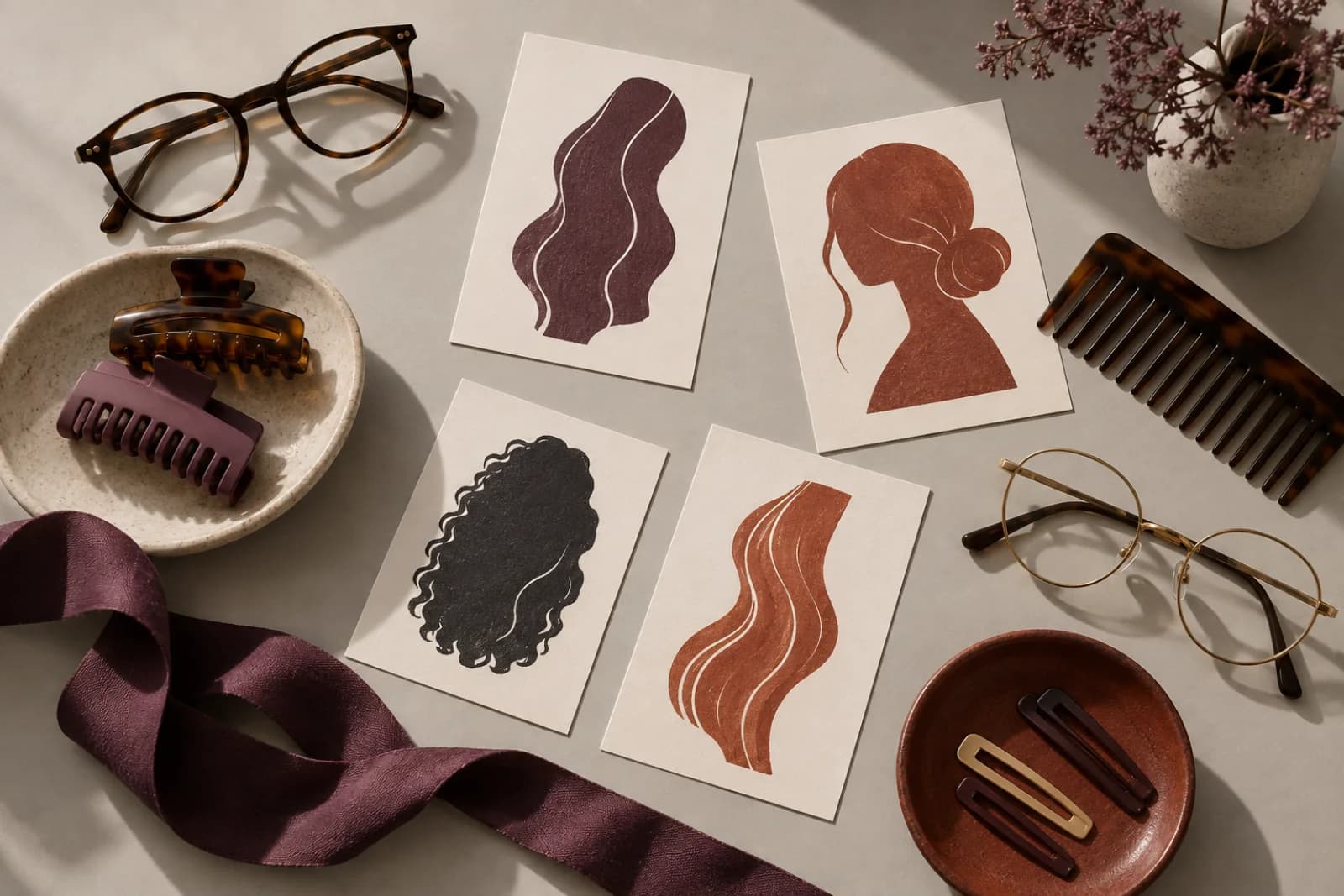
Short hair with glasses can make the frames look intentional because the face stays visible, but “short” covers very different commitments. A pixie exposes the temples and requires shape maintenance. A jaw-length bob creates a clear line near the lower rim and may need control at the sides. A collarbone cut offers enough length to tie back while still framing the face. Long hair gives flexibility, yet heavy front sections may keep falling onto the arms unless the layer map supports a tuck.
Write down your non-negotiable actions: wearing headphones, changing into sunglasses, cycling, working with hair tied back, or letting it air-dry. A good haircut survives those actions. If you regularly remove your glasses, check how the cut reads without their structure. If you alternate between narrow and oversized frames, choose a flexible face frame rather than calibrating every strand to one exact rim. Everyday compatibility is a stronger criterion than a flattering single angle.
Compare haircuts with glasses one variable at a time
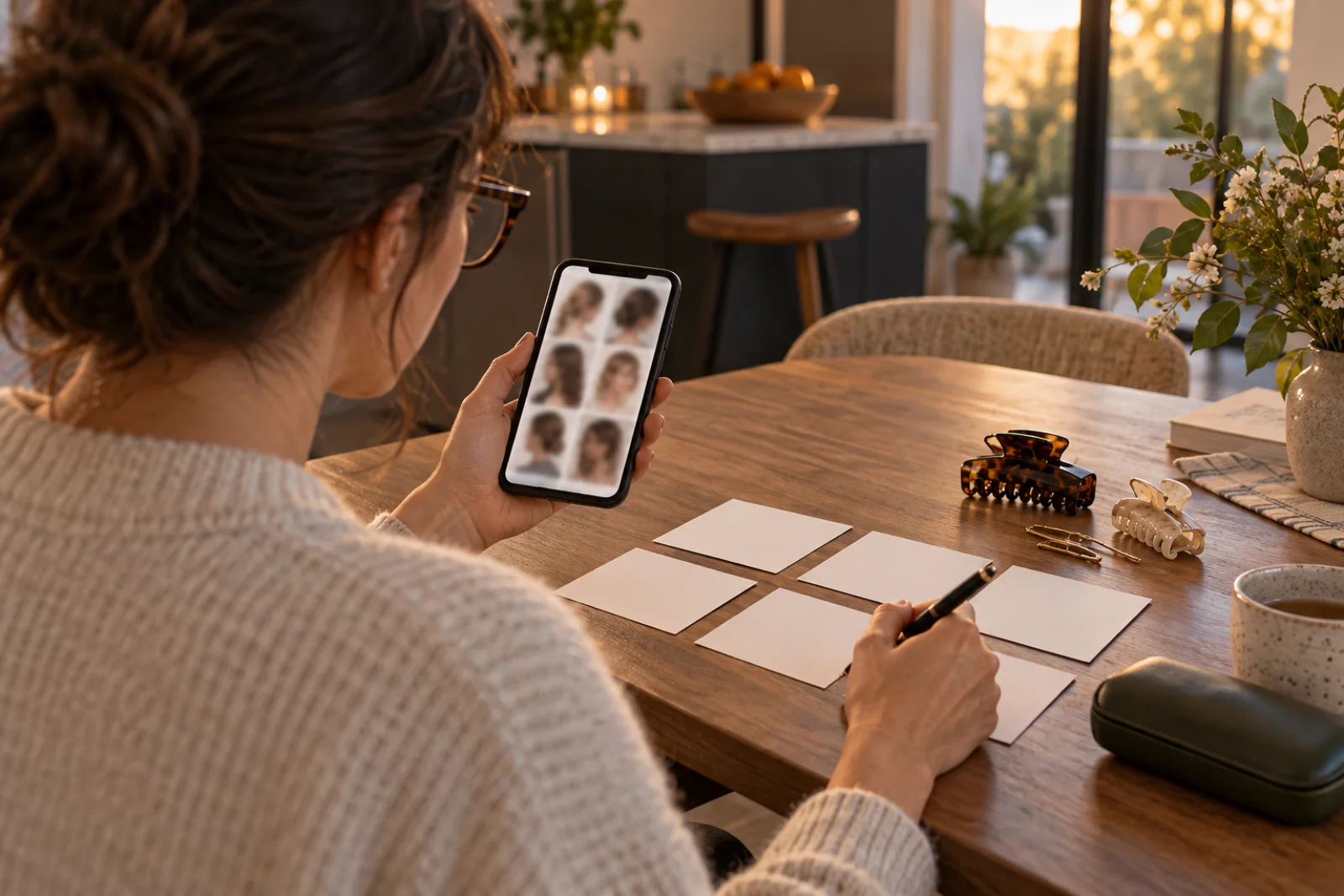
A preview becomes useful when your everyday frames remain visible and the experiment is controlled. Use one clear, front-facing photograph in neutral light. Keep color, expression and styling finish stable while comparing one variable: open forehead versus fringe, blunt versus softly layered, jaw versus collarbone, or tucked versus loose. If every preview also changes color, volume and lighting, you cannot tell whether you like the haircut or simply the presentation.
Hair Muse can help create that controlled shortlist. The app is free to download, with some uses or features available through in-app purchases. HairChapter and Hair Muse share a publisher; the preview is offered as a planning tool, not a guarantee of fit, texture behavior or salon outcome. Save two or three versions and write one sentence beneath each: what works around the frame, what might become annoying and what you need the stylist to assess in person.

Build a salon brief that includes comfort and restraint
Bring your everyday glasses, a second pair if you switch often, and photographs of your hair in its normal dry state. Explain how often you tuck, tie back or wear headphones. Instead of saying “make it suit my glasses,” identify the practical outcome: “I want the frame visible, the temple clear and enough length to secure the front on workdays.” Show the stylist where the arms sit and ask to review the front pieces with the glasses on before the final refinement.
Avoid solving frame interference by pulling the hair painfully tight. The American Academy of Dermatology warns that repeated tension from tight styles can contribute to traction hair loss. Your cut should create a comfortable route around the frames rather than requiring force every morning. Ask for a soft restraint option, a quick refresh for the fringe and the expected grow-out at four, eight and twelve weeks. That converts a visual preference into a maintainable system.
Use a final decision matrix before you book
Score each candidate from one to five on frame clearance, dry-texture behavior, tie-back usefulness, styling time and grow-out. Add a sixth score for how much you actually like it. A technically compatible haircut that does not feel like you is not the winner. Eliminate any option that depends on a finish you will not reproduce, hides the lenses when you need clear vision or feels comfortable only when perfectly arranged.
Take the top two options to the consultation. Ask the stylist which version fits your density, growth patterns and maintenance limit, then agree on a fallback: a longer fringe, fewer face-framing sections or a less severe perimeter. Glasses are not a restriction that demands a special category of haircut. They are one stable element in a larger system. When the frame, hair behavior and routine are evaluated together, the final choice becomes clearer and easier to live with.
Choose the cut that works after the mirror moment: during the commute, at the desk, with headphones and on an air-dry day.
Three terms that make this conversation clearer.
You do not need to prescribe technique. Use these words to describe the visible structure, name the behavior you want, and ask what your stylist would adapt.
Perimeter
The outside boundary of the haircut: the line you read around the bottom, sides, and overall edge. A compact perimeter usually feels fuller and more controlled, while a broken or highly layered perimeter can feel lighter, softer, or more textured.
SAY IT IN THE CHAIR“I like the movement, but I want the outside edge to remain substantial when the hair is straight or air-dried.”Open full definition
Layer map
A plain-language way to describe where the shortest layers begin, how quickly they connect to longer sections, and where movement or volume is intended to appear. Two haircuts with the same overall length can feel completely different because their layer maps differ.
SAY IT IN THE CHAIR“Show me the shortest layer, where it connects, and how much weight remains beneath it.”Open full definition
Silhouette
The complete outside shape a haircut creates when viewed as a whole: compact, rounded, triangular, elongated, wide, narrow, or deliberately irregular. It is often the most reliable feature to compare before discussing small details or a polished finish.
SAY IT IN THE CHAIR“I want this overall shape, but I am open to changing the internal technique for my hair.”Open full definition
Turn this guide into a decision.
Three honest answers are more useful than ten additional reference photos. Your responses stay on this page and can be changed at any time.
- 01Can you point to the exact structural detail you want from this cut?
Name the shortest point, outside line, layer map, or placement of volume.
- 02Have you named the boundary you do not want traded away?
Examples: tie-back length, full ends, an open forehead, dry length, or support for natural texture.
- 03Does the plan fit your real styling and maintenance rhythm?
Count ordinary mornings, fallback styles, trim frequency, and the way the shape is likely to grow.
The short answers.
What haircut looks good with glasses?
Any length can work. Prioritize a clear plan for the brow line, temple-and-ear zone and face-framing pieces, then choose the silhouette you genuinely like and can maintain.
Do bangs work with glasses?
Yes. Test the dry landing point and movement: above the rim, lightly skimming it or opening around it. Avoid a length that constantly falls between your eyes and lenses.
Should hair cover the arms of glasses?
It can, but it should not catch painfully or push the frames out of position. Decide whether pieces will sit outside, above or securely behind the ear.
Are short haircuts better with glasses?
Not inherently. Short cuts can expose the frames clearly, while longer cuts offer tie-back flexibility. Routine, texture and maintenance matter more than length alone.
Can a hairstyle preview show the exact result?
No. A preview can compare broad shape choices, but it cannot predict density, shrinkage, growth patterns, frame fit or the exact result of a real haircut.
How this guide was built.
HairChapter separates haircut structure from styling, trend names, and medical claims. Our recommendations are decision tools, not universal rules: a stylist should adapt the direction to your starting length, density, pattern, condition, growth habits, and normal routine.
We do not claim that a photograph or AI preview can predict a finished service. Sudden shedding, patchy loss, scalp pain, persistent irritation, or an unexplained change in density belongs with a qualified medical professional—not a haircut guide.
Sources for health-related statements
- Mayo Clinic Health System — How to find the right glasses Frame fit and proportion as a separate eyewear decision.
- American Academy of Dermatology — Hairstyles that pull can lead to hair loss Why a practical glasses-friendly style should not depend on painful, repeated tension.