
A hime cut changes the front more than the total length
A hime cut keeps a noticeable break between shorter front side sections and the longer hair behind them. Choose it when that separate edge is the detail you want, not merely because you hope to keep most of your length. Before booking, decide where the short pieces may finish when dry, how much hair they may occupy and whether they must tuck or fasten away. Those decisions determine the commitment more clearly than the long back does. A photograph can make the change look small because the longest hair remains; your everyday front sections may nevertheless behave very differently.
JATAI Academy demonstrates a classic arrangement with distinct front sections, a fringe and longer rear lengths. That structure helps identify the request, but it is not a compulsory recipe for every head. Bring a reference showing the detail you mean and distinguish its separate edge from a smooth progression of face-framing layers. A version with an open forehead is a different brief from one with a full fringe. Describe both choices explicitly. This guide concerns deciding on those sections with a professional, not copying a cutting tutorial or assigning yourself a standard section width.
Decide whether you want a visible break or a blended frame
Look closely at the lower edge of the short side pieces. Is there an obvious step to the long hair, or do intermediate lengths soften the transition? If the sharp step is what you like, say that you want it to remain readable when the hair is worn down. If you mainly want movement around the cheeks, a connected face frame may answer the wish with less contrast. Neither choice is more sophisticated. They solve different visual requests, and asking for one while showing a reference of the other is a common source of an unclear consultation.
Use a front image and a side view rather than a collection of unrelated finished looks. Point out the edge you want kept distinct and the longer area that should not be drawn into it. Also identify what you dislike: perhaps a very wide panel feels too heavy, or a short edge at the mouth is more present than you expected. Ask the stylist whether your existing layers leave enough length to build the chosen separation. Keeping the back long does not guarantee that the front can be recreated exactly from someone else’s photograph.
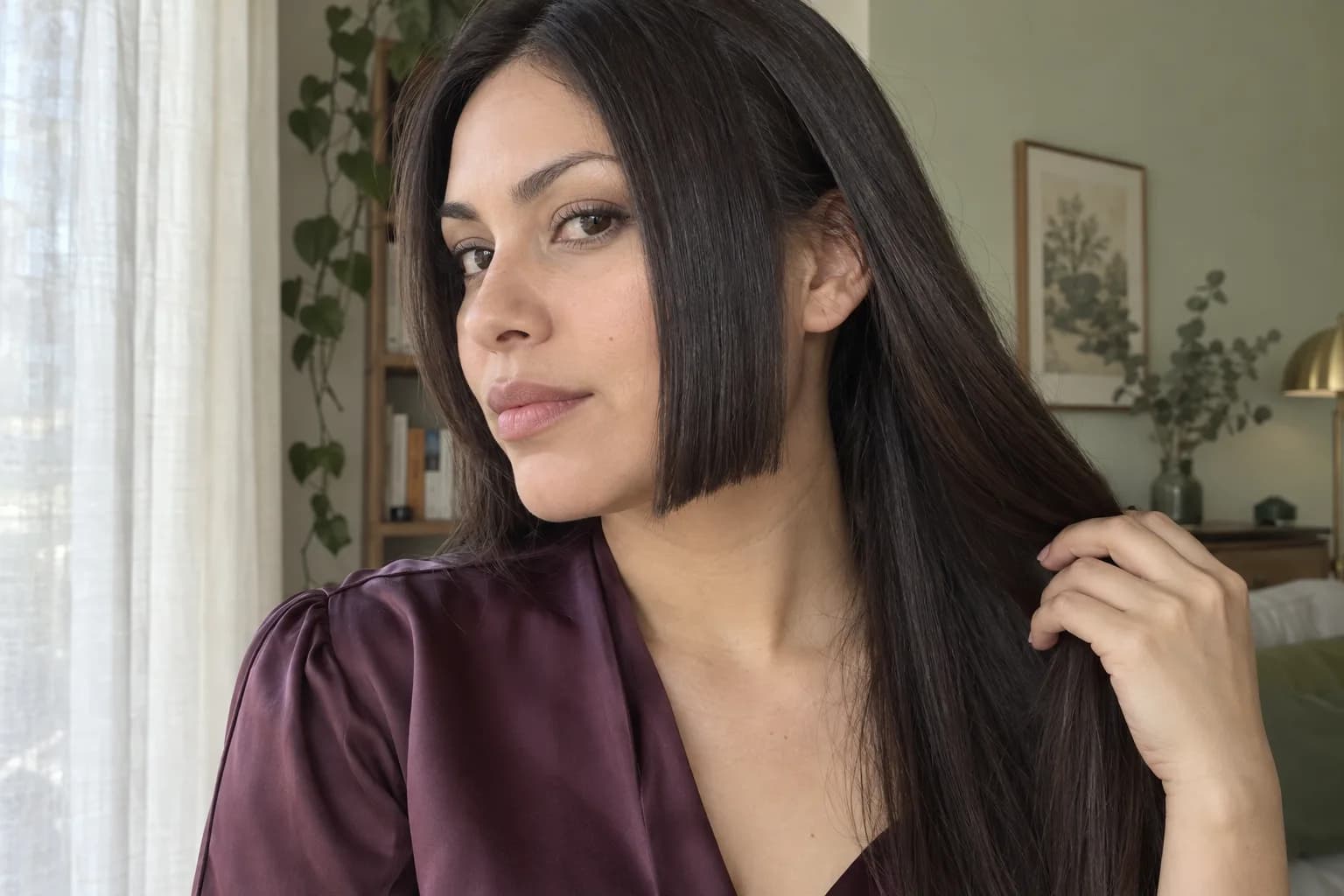
Agree the dry endpoint and the amount of hair separately
A cheek-level panel and a below-jaw panel are not interchangeable just because both references are called hime. Point to the shortest acceptable position while sitting upright with your usual part. Then ask the stylist to show how much front hair would be included. Length describes where the edge lands; section size describes how prominent that edge becomes and how much hair remains in the longer sides. Do not borrow a centimeter measurement from a tutorial. It cannot account for your hairline, density, existing layers or the place where your hair naturally changes direction.
Look at both sides without forcing them into a pose you never wear. Small differences in growth direction can make equivalent lengths sit differently. Tell the stylist whether visual balance or precisely matching measurements is the priority, and let them assess what is achievable. If you are uncertain, discuss a longer first endpoint that still expresses the intended contrast. You can review it dry before accepting further shortening. Do not keep reducing the front merely because each new cut makes the original reference seem closer. The useful boundary is your agreed wearable length, not the photograph’s smallest detail.
Check the texture you will actually wear
A sleek reference shows the edge clearly, but it may also show a finish that takes effort on your own hair. Explain whether you normally wear the front straight, wavy or curly and whether that changes between wash days. Ask to judge the proposed endpoint in that ordinary state. With a bend or curl, the edge may appear less horizontal even when the haircut deliberately separates the front from the back. Decide whether that textured interpretation appeals to you. You do not have to promise daily straightening simply to qualify for a hairstyle name.
Density belongs in the discussion too. A wider front section takes hair out of the longer side area; ask the stylist to show the remaining outline before you approve it. On denser hair, a full short panel may feel very present, while a narrow one may be hidden among the lengths. Those are observations to make on your own hair, not rules that exclude fine or thick textures. Request a realistic ordinary finish as well as the polished one. If the contrast only looks right after a routine you dislike, changing the brief is more useful than hoping the haircut will remove that effort.


Use a preview to name the contrast, not measure the cut
Once the practical boundaries are clear, Hair Muse can help compare a more separate-looking front with a softer silhouette on your own photo. Start with one evenly lit portrait, the normal part visible and no heavy filter. Choose a small number of available styles that represent the contrast you want to discuss. A catalog may not include your exact hime version; do not label a nearby preview as proof of a custom panel shape. Keep the original portrait alongside the comparison and write what you prefer: a clearer short edge, a less crowded front or an open forehead.
HairChapter and Hair Muse share a publisher. Hair Muse is free to download; some uses or features may require in-app purchases. The official App Store invitation is optional, and this is not an independent product test. A preview cannot establish section width, true density, real hair behavior, chemical color results, exact fit or salon feasibility. Compare one meaningful difference at a time instead of changing length, color and fringe together. The result should be a clearer question for the stylist. Your real hair and the fastening limits you already established remain the deciding evidence.
Try your fastening routine before giving up front length
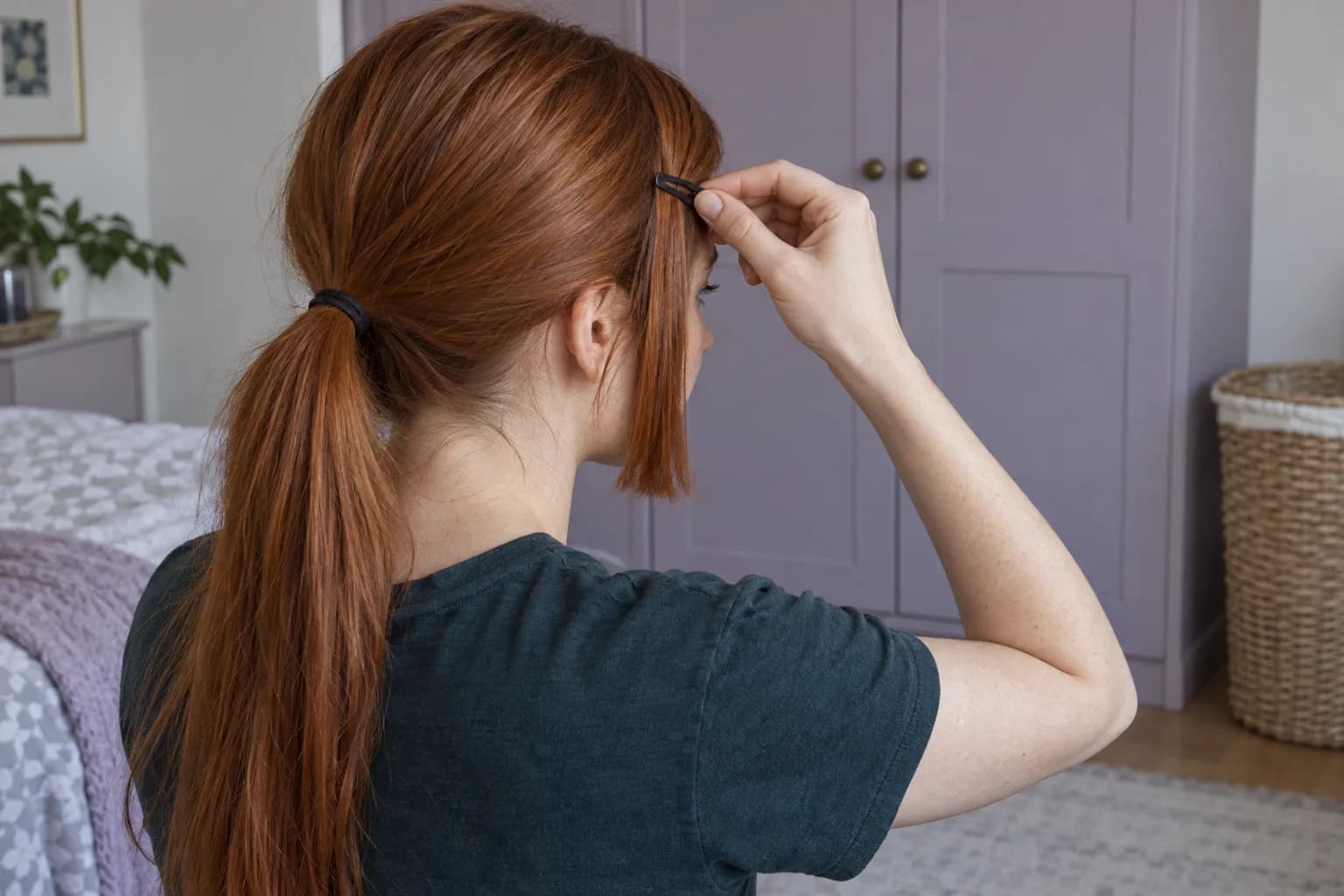
Gather your hair as you do for work, exercise or cooking. Ask which of the proposed short sections would no longer reach that fastening. A long ponytail at the back does not mean every front piece still joins it. Try your normal ear tuck and any clip you are willing to use; turning your head and looking down can reveal a requirement that a still photograph hides. This is a consultation check, not an exact simulation of the finished cut. If every piece must stay in one fastening, make that a boundary before the front is shortened.
An alternative clip is useful only if you will actually carry and wear it. Consider glasses, headphones, earrings and any uniform or headwear you use regularly. A short edge may sit where an accessory rests, and there is no universal cheek length that avoids every contact point. Tell the stylist which interactions bother you and which loose sections you enjoy. Do not assume a later styling product will solve an agreed length that cannot reach behind your ear. If your practical requirement conflicts with the graphic reference, choose a longer panel or a different face frame rather than hiding that conflict.
Treat upkeep and growing out as two different plans
Keeping the visible step means revisiting the short front edge when it stops landing where you want it. Growing out means allowing that edge to move, even if it no longer matches the first photograph. Decide which plan you expect before scheduling the next visit. Ask whether a front-only appointment is available and what it would preserve in the longer shape. Avoid a fixed online trim interval: your preferred endpoint, texture, tolerance for a softened edge and appointment access all matter. You can keep the back long while choosing not to refresh the original short front.
If you later want one continuous shape, ask which longer destination is useful and which surrounding pieces can stay intact while the front approaches it. Cutting all the back shorter may create a connection sooner, but it also gives up the length you deliberately retained. Gradual blending changes the appearance of the step without instantly replacing missing length. There is no reliable universal date for completion. At that later decision, a saved Hair Muse comparison may help explain whether you prefer keeping the contrast or moving toward a connected frame; it cannot predict your growth or tell a stylist how much to remove.
Bring a brief with three clear boundaries
Before the appointment, write the shortest acceptable dry endpoint, the amount of front hair you are willing to separate and the longer area you want preserved. Add whether the forehead remains open, what fastening must still work and which texture you intend to wear. Bring one current dry photograph and two relevant views of the reference. Ask the stylist to identify any mismatch between that plan and your actual lengths. Resolving it while the hair is still intact is preferable to discovering afterward that keeping the back long did not protect a front section you needed.
At the final review, look straight ahead, check each side and try the ordinary movements you discussed. Confirm what needs styling and what the next appointment should change, if anything. Do not assess the cut only with the short panels arranged perfectly for a photograph. If something feels different, describe the location and behavior before agreeing another shortening. You may want a styling adjustment, a longer future endpoint or a narrower section next time. A considered hime decision leaves you with a recognizable front contrast and honest expectations—not a promise that preserving total length makes the change automatically reversible.

Three terms that make this conversation clearer.
You do not need to prescribe technique. Use these words to describe the visible structure, name the behavior you want, and ask what your stylist would adapt.
Perimeter
The outside boundary of the haircut: the line you read around the bottom, sides, and overall edge. A compact perimeter usually feels fuller and more controlled, while a broken or highly layered perimeter can feel lighter, softer, or more textured.
SAY IT IN THE CHAIR“I like the movement, but I want the outside edge to remain substantial when the hair is straight or air-dried.”Open full definition
Layer map
A plain-language way to describe where the shortest layers begin, how quickly they connect to longer sections, and where movement or volume is intended to appear. Two haircuts with the same overall length can feel completely different because their layer maps differ.
SAY IT IN THE CHAIR“Show me the shortest layer, where it connects, and how much weight remains beneath it.”Open full definition
Silhouette
The complete outside shape a haircut creates when viewed as a whole: compact, rounded, triangular, elongated, wide, narrow, or deliberately irregular. It is often the most reliable feature to compare before discussing small details or a polished finish.
SAY IT IN THE CHAIR“I want this overall shape, but I am open to changing the internal technique for my hair.”Open full definition
Turn this guide into a decision.
Three honest answers are more useful than ten additional reference photos. Your responses stay on this page and can be changed at any time.
- 01Can you point to the exact structural detail you want from this cut?
Name the shortest point, outside line, layer map, or placement of volume.
- 02Have you named the boundary you do not want traded away?
Examples: tie-back length, full ends, an open forehead, dry length, or support for natural texture.
- 03Does the plan fit your real styling and maintenance rhythm?
Count ordinary mornings, fallback styles, trim frequency, and the way the shape is likely to grow.
The short answers.
Can I have a hime cut without bangs?
You can discuss an open-forehead version with distinct shorter side sections. Show that variation explicitly; a classic full-fringe reference does not communicate the same request. Agree the front panels and forehead choice separately.
Will a hime cut keep all my hair long?
It can retain the longer back, but the front panels become shorter. Those pieces may stop reaching your ponytail or ear tuck. Protecting overall length is not the same as preserving every fastening option.
Can the front panels work on wavy hair?
Discuss an interpretation in the texture you actually wear. Waves may change the visible edge and dry endpoint. Assess that appearance with the stylist instead of assuming a sleek reference proves an effortless straight finish.
How do I grow out the short side pieces?
Choose whether to retain the contrast, soften it gradually or eventually join a longer outline. Preserve useful length while discussing that destination. Blending can change the appearance but cannot instantly restore the shorter sections.
Can a preview tell me the correct panel width?
No. A preview can clarify the contrast you like, not measure the hair available or determine a safe section on your head. Your stylist needs to assess real density, existing lengths, growth direction and practical requirements.
How this guide was built.
HairChapter separates haircut structure from styling, trend names, and medical claims. Our recommendations are decision tools, not universal rules: a stylist should adapt the direction to your starting length, density, pattern, condition, growth habits, and normal routine.
We do not claim that a photograph or AI preview can predict a finished service. Sudden shedding, patchy loss, scalp pain, persistent irritation, or an unexplained change in density belongs with a qualified medical professional—not a haircut guide.
Professional context, not a universal formula
- JATAI Academy — hime haircut structure A professional demonstration of separate front sections, a fringe and a longer back. Cutting instructions, tool promotion, historical claims and easy-styling promises are not adopted.