
Identify which layers you are actually growing out
“Too layered” can describe several different problems: short crown pieces that create too much lift, face framing that begins too high, heavy disconnection between top and bottom, or a perimeter that feels thin. Photograph the haircut air-dried or in its usual finish and trace where the shortest movement begins. Then look at the bottom line separately. The recovery plan depends on which zone lost the balance.
Choose the first priority. If fullness matters most, protect the lower outline and avoid adding new short layers. If retaining maximum length matters most, accept that the perimeter may take longer to feel dense. If movement still suits you but the contrast is too strong, the goal may be a longer, lower layer map rather than a completely blunt cut.
Choose staged reshaping or a decisive reset
A decisive reset brings the longest line closer to the shortest layers, creating a fuller outline sooner at the cost of length. Staged reshaping removes smaller amounts from the perimeter while allowing the interior to catch up. Neither route is morally better. The useful choice reflects which loss—visible layers or overall length—would bother you more during the transition.
Ask a stylist to show the shortest interior point and the proposed perimeter before choosing. A reference photo of one-length hair can hide subtle internal work, so describe the visible outcome you want: substantial ends, quieter crown movement, a lower starting point, or a more connected face frame. Leave technique open to the person assessing your density and condition.
Growing out layers is a priority decision: fullness sooner, or length preserved. Name which one wins.
Protect the perimeter from repeated thinning
When the ends already feel light, repeated texturizing can extend the problem even if it makes the fresh salon finish look airy. State clearly that you want to rebuild visual weight at the bottom. Ask whether bulk can be managed internally without making the outer edge more transparent, and ask to see how the perimeter looks without curls or a voluminous blowout.
Fine, dense, straight, wavy, curly, and coily hair reveal layer contrast differently. Shrinkage can make the shortest areas appear much higher; straight hair can expose every change in the edge. Judge the plan in your usual dry state. “Fuller” is a visible target, but the safest technical route depends on the hair in front of the stylist.
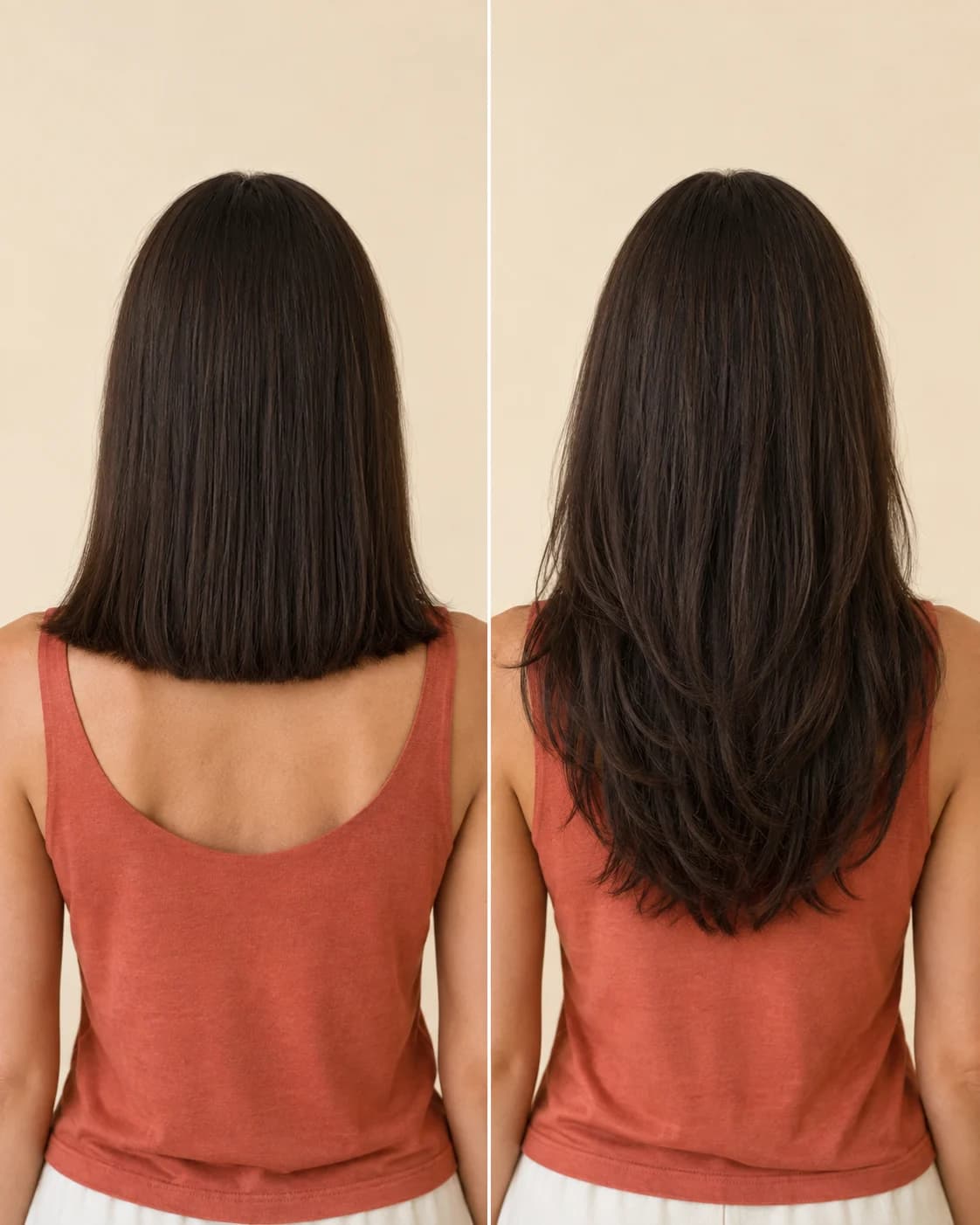
Use styling to reduce contrast, not disguise reality
The same layer map can look more or less dramatic depending on bend, part, volume, and finish. A smoother outline may visually connect sections; consistent wave direction may make gaps less obvious; changing the part can redistribute a short crown. Ask for one low-effort method that works with your texture and does not require high heat every day.
Fallback styles can expose whether the short sections reach a tie-back, braid, twist, or clip. Record which pieces fall out and whether that affects work, exercise, or sleep. That practical information belongs in the next consultation. The aim is not to hide the haircut in every photo; it is to keep ordinary days manageable while the proportions change.
Review the map at each maintenance visit
Bring the original baseline and a current photo so the stylist can see which sections have begun to connect. Ask what would be removed from the perimeter, whether any new short pieces are planned, and how the service moves the layer map lower. A dusting, perimeter trim, or targeted reshape should each have a named role rather than being treated as interchangeable.
When the shortest layers reach a useful landmark—below the jaw, past the shoulder, or inside your usual tie-back—decide whether a final fuller reset still matters. You may discover that a quieter long-layered shape now offers the density and movement you wanted. Grow-out succeeds when the haircut becomes coherent again, not only when every strand is technically equal.
- Current layer map
- Fullness-versus-length priority
- Perimeter boundary
- No new short layers unless agreed
- Next connection landmark
Three terms that make this conversation clearer.
You do not need to prescribe technique. Use these words to describe the visible structure, name the behavior you want, and ask what your stylist would adapt.
Maintenance window
The period during which a haircut still performs the job it was designed to do before a particular detail needs reshaping. The true window is set by the first meaningful change—often a fringe, nape, perimeter, crown, or loss of internal balance.
SAY IT IN THE CHAIR“Which detail will stop working first, and what is a realistic return window for that part?”Open full definition
Baseline
The lower edge or foundation of a haircut, especially visible in bobs and other compact shapes. A strong baseline can make the ends read as fuller and more graphic; a softer or broken baseline can make the outline feel lighter and less exact.
SAY IT IN THE CHAIR“I want the bottom line to feel complete, but not so sharp that the grow-out looks abrupt.”Open full definition
Consultation brief
A short, usable description of the result you want and the reality it must support. The strongest brief combines one structural change, one non-negotiable boundary, your normal styling routine, and a question that invites the stylist to adapt the plan.
SAY IT IN THE CHAIR“I want to change this, keep this boundary, and make sure the result still works when I style it this way.”Open full definition
Turn this guide into a decision.
Three honest answers are more useful than ten additional reference photos. Your responses stay on this page and can be changed at any time.
- 01Can you name the next visible milestone instead of only saying “longer”?
Choose a tuck, tie-back, connection point, or silhouette—and identify which length must be protected to reach it.
- 02Have you named the boundary you do not want traded away?
Examples: tie-back length, full ends, an open forehead, dry length, or support for natural texture.
- 03Does the plan fit your real styling and maintenance rhythm?
Count ordinary mornings, fallback styles, trim frequency, and the way the shape is likely to grow.
The short answers.
Do I have to cut my hair short to grow out layers?
No. Cutting closer to the shortest layer creates a fuller outline sooner, but staged perimeter trims can preserve more overall length. Decide whether fullness or length is the higher priority.
Can a stylist blend out layers without cutting more?
Blending normally changes some hair, so ask exactly which sections would be cut and how. Sometimes styling or waiting preserves more useful length; sometimes a targeted connection improves the shape. An in-person assessment is needed.
How this guide was built.
HairChapter separates haircut structure from styling, trend names, and medical claims. Our recommendations are decision tools, not universal rules: a stylist should adapt the direction to your starting length, density, pattern, condition, growth habits, and normal routine.
We do not claim that a photograph or AI preview can predict a finished service. Sudden shedding, patchy loss, scalp pain, persistent irritation, or an unexplained change in density belongs with a qualified medical professional—not a haircut guide.