
Middle part vs side part is a framing decision
Middle part vs side part is easier to decide when you stop treating either option as a verdict on your age or face. A central division sends the front in two directions; a side division transfers more hair across one side. That can change forehead exposure, the location of a sweep and the weight near your cheeks. It does not change your features or automatically make the whole haircut symmetrical. Start with a small question: would you like a more open front, a diagonal sweep, or less hair falling into your eyes?
Keep this separate from cutting. Try moving the part on the hair you already have before asking for a new fringe or shorter layers. A modest off-centre position is also a real option, not an unsuccessful centre part. Matrix’s professional guidance includes a slightly off-centre position as one way to soften the look of a central division. Your preference and the work required to keep it matter more than a rigid rule. Choose one everyday goal, such as an unobstructed face at your desk, so the comparison has something concrete to answer.
First change direction. Only then decide whether the haircut needs changing.
Observe the roots before drawing a precise line
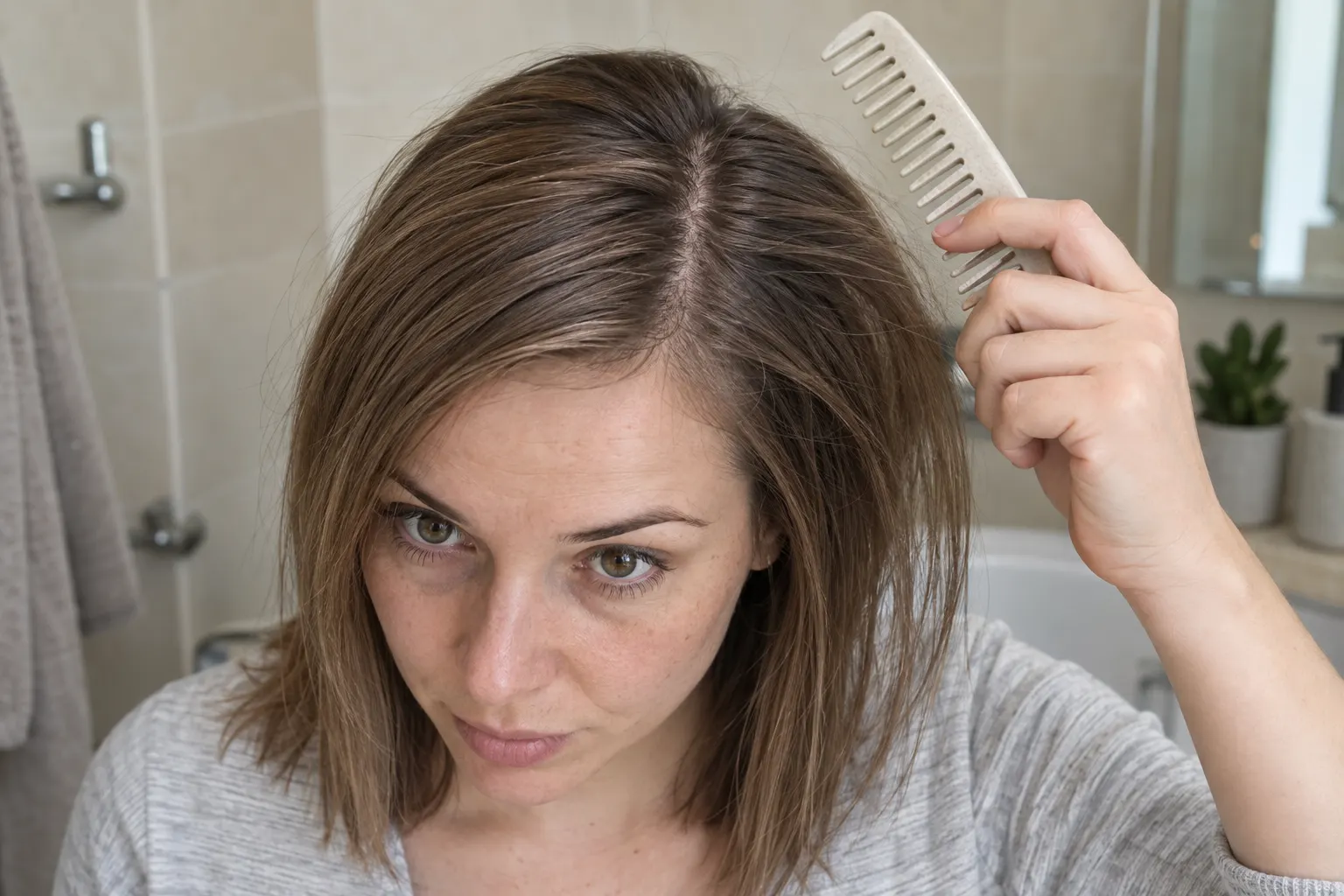
Begin with your usual dry hair, without adding a new styling product for the test. Gently loosen the front with your fingers and watch where it separates. Look at the hairline and the first few centimetres behind it. Does one side lift, fold over or split again when released? That observation is more useful than insisting that a comb line must continue perfectly from forehead to crown. A part can begin near the centre and soften farther back if that is how the hair settles.
Try the smallest move first. Shift the front slightly, release it and check again rather than taking a deep sweep immediately. If the roots keep returning, decide whether a little styling is an acceptable daily step. Do not interpret resistance as something wrong with your hair. Growth direction is a practical constraint, not a beauty defect. If the whole front springs up or opens unexpectedly, show the behaviour to a stylist rather than compensating with heavy product or asking for short pieces that may be harder to control.
- Release the roots instead of holding the new line.
- Compare a small shift before a deep side sweep.
- Note what happens at the hairline and farther back.
- Keep the test comfortable and reversible.
Compare distribution, not an illusion of more hair
A side part can put more of the existing hair on one side, but it cannot create density. Check both the fuller side and the side you have taken hair away from. If one looks appealing only because the other disappears outside the photograph, the test is incomplete. With fine hair, ask whether the new position stays airy without constant lifting. With dense hair, ask whether the transferred section feels heavy or keeps sliding across the face. The visible result and the physical experience can disagree.
A centre part does not promise equal fullness either. Your two sides may differ in texture, length or the way they settle. You can enjoy that natural difference without trying to correct it with scissors. Compare the overall outline from the front and each side, then move your hands away. If you prefer a little imbalance, keep it intentional. If you want freedom to switch, protect that freedom before approving a cut strongly designed around one direction. Photograph both sides rather than selecting only your favourite angle.
Keep waves and curls in their normal groups
For waves or curls, a razor-straight part may require splitting a group that normally dries together. You do not need to force that line to judge the broader framing. Start with a soft separation between groups and let the hair dry in the finish you normally wear. Notice whether the new front remains connected to the rest of the shape or creates an isolated strand that behaves differently. Judge the complete dry outline, not a stretched section that gives a temporary impression of extra length.
Avoid repeatedly dragging a comb through dry curls simply to make both photographs look identical. A fair test preserves your ordinary texture rather than replacing it with a smoother version. When you next style damp hair, set a gentle direction using your usual method and reassess after drying. The American Academy of Dermatology advises gentle handling and limiting excessive heat. You do not need a high-heat routine to qualify for a particular part. If the look only works with more effort than you want, that is useful information rather than a failed experiment.

Make a controlled visual comparison
A different part can feel unfamiliar before you have even seen it clearly. Take a front-facing picture in soft light, with the whole hairline visible and the camera at the same height for each version. Keep clothing, expression, texture, length and colour unchanged. Compare a central or slightly off-centre version with one shallow side part. Avoid changing the cut at the same time: otherwise you will not know whether you prefer the direction, the new length or simply a more flattering photograph.
Hair Muse can help you picture broad framing alternatives when a mirror test leaves the visual preference unclear. Use the same source portrait and keep the comparison narrow; save the original alongside the alternatives. If a result changes your face, invents density or alters the fringe as well as the part, discard it as an unfair comparison. HairChapter and Hair Muse share a publisher. Hair Muse is free to download; some use or features may require in-app purchases. Its images are planning aids, not evidence of real root behaviour, density or salon feasibility.
Check the front length before changing the cut
Moving a front section across the forehead changes its route. A piece that stays beside the cheek in one part may land near an eye in another, or fail to reach the ear you usually tuck it behind. Look down, turn sideways and try your normal tuck without pulling. Decide which outcome you can live with: a deliberately loose sweep, a quick tuck, an occasional clip, or a clear face without help. These are different routines, even if the still pictures look equally convincing.
Existing bangs need a separate check. A centre-opening fringe, short blunt fringe and long side sweep cannot always exchange places without changing the rest of the front. Do not trim one stubborn strand at home to make a temporary part work; you may lose the length that made the old direction comfortable. Ask a stylist to show the front in both positions and explain any compromise. If switching matters more than a sharp one-sided finish, say so. The cutting plan should follow your intended flexibility, not only the reference you brought.

Translate the favourite image into a salon request
Keep the original portrait and no more than two useful finalists. In Hair Muse, treat a preferred preview as a way to describe an open forehead, a shallow diagonal sweep or the location of front volume. Do not ask the stylist to reproduce every pixel. A generated image cannot test your growth direction, assess the physical thickness of a section or establish whether an existing fringe can fall that way. The real dry-hair assessment decides those questions, even when the preview looks convincing.
Explain both the preferred look and the limit on effort. For example, you may like the side sweep but not want to reset it every hour; or prefer the centre framing while accepting that the line will be soft rather than exact. Ask what can be achieved through styling before discussing removal of length. If you regularly switch sides, request a check of the outline in both directions before the final trim. A useful consultation ends with an agreed everyday version and an optional more styled version, not a promise that every part behaves identically.
Wear the part through an ordinary day
Choose a normal day for the final test, not an occasion when you are happy to keep adjusting your hair. Read, walk, put on your usual jacket and check the front when you look down. Notice how often you touch it and whether you still like it after the first styled hour. A short note is enough: direction, styling steps, eye clearance and how it looked later. Repeat the alternative under similar conditions before deciding that one is genuinely easier.
You can keep two options. One may suit air-dried mornings while another is worth the extra styling for an evening. You can also keep the familiar part if the new one offers no useful improvement. There is no deadline or age rule to satisfy. If a change requires shortening the front, make that a second decision after you have tested the direction. The successful result is a part you enjoy and can maintain within your routine, with a haircut that still leaves the flexibility you asked for.

Three terms that make this conversation clearer.
You do not need to prescribe technique. Use these words to describe the visible structure, name the behavior you want, and ask what your stylist would adapt.
Perimeter
The outside boundary of the haircut: the line you read around the bottom, sides, and overall edge. A compact perimeter usually feels fuller and more controlled, while a broken or highly layered perimeter can feel lighter, softer, or more textured.
SAY IT IN THE CHAIR“I like the movement, but I want the outside edge to remain substantial when the hair is straight or air-dried.”Open full definition
Layer map
A plain-language way to describe where the shortest layers begin, how quickly they connect to longer sections, and where movement or volume is intended to appear. Two haircuts with the same overall length can feel completely different because their layer maps differ.
SAY IT IN THE CHAIR“Show me the shortest layer, where it connects, and how much weight remains beneath it.”Open full definition
Silhouette
The complete outside shape a haircut creates when viewed as a whole: compact, rounded, triangular, elongated, wide, narrow, or deliberately irregular. It is often the most reliable feature to compare before discussing small details or a polished finish.
SAY IT IN THE CHAIR“I want this overall shape, but I am open to changing the internal technique for my hair.”Open full definition
Turn this guide into a decision.
Three honest answers are more useful than ten additional reference photos. Your responses stay on this page and can be changed at any time.
- 01Can you point to the exact structural detail you want from this cut?
Name the shortest point, outside line, layer map, or placement of volume.
- 02Have you named the boundary you do not want traded away?
Examples: tie-back length, full ends, an open forehead, dry length, or support for natural texture.
- 03Does the plan fit your real styling and maintenance rhythm?
Count ordinary mornings, fallback styles, trim frequency, and the way the shape is likely to grow.
The short answers.
Is a middle part or side part better for a round face?
Neither is compulsory. Compare how much forehead you want visible, where the front volume sits and how the hair behaves during the day. A face-shape label cannot tell you which direction you enjoy or how much resetting it requires.
Can I change my part without a haircut?
Often you can test a different direction with your existing length. Start with a small shift and check the dry result. An asymmetric cut or short fringe may limit the change, so test the front before removing any length.
Will a side part make fine hair thicker?
It redistributes the hair you have rather than increasing density. Look at the lighter side as well as the fuller side and check whether the effect stays comfortable without repeated lifting or heavy product.
Should a curly middle part be perfectly straight?
Not necessarily. A soft line between natural curl groups may fit your everyday texture better. Assess the complete dry shape without repeatedly combing through the curls just to draw a precise line.
Can a preview show which part will stay in place?
No. It can help you articulate a visual preference, but cannot verify real root direction or front-piece reach. Keep the original photo and test your actual hair before building a haircut around the preview.
How this guide was built.
HairChapter separates haircut structure from styling, trend names, and medical claims. Our recommendations are decision tools, not universal rules: a stylist should adapt the direction to your starting length, density, pattern, condition, growth habits, and normal routine.
We do not claim that a photograph or AI preview can predict a finished service. Sudden shedding, patchy loss, scalp pain, persistent irritation, or an unexplained change in density belongs with a qualified medical professional—not a haircut guide.
Sources for health-related statements
- Matrix — professional guidance on hair parts A slightly off-centre part is an option alongside central and side positions.
- American Academy of Dermatology — everyday hair care Expert advice on gentle handling and limiting styling heat.