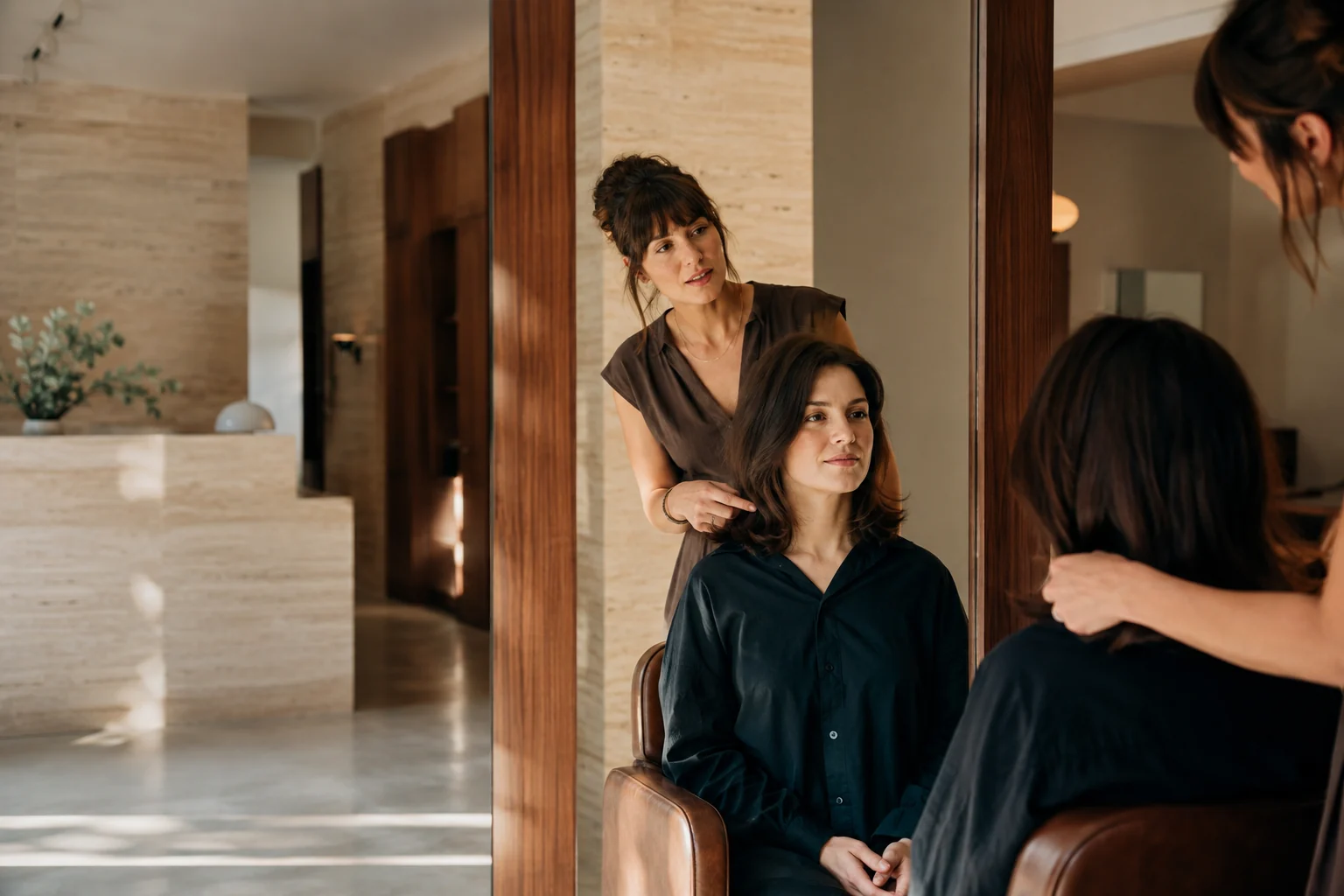
Side-swept bangs are a one-sided cut, not merely a side part
Side-swept bangs place a shorter front section diagonally across the forehead toward one side. The useful question is not whether that label suits your face shape, but how much hair you want crossing your forehead and where it should stop. L’Oréal Paris distinguishes this diagonal fringe from curtain bangs that open to both sides. That vocabulary helps explain a photograph, but it does not specify your personal cut. A long piece moved sideways can resemble bangs without having the same shorter starting point. Identify whether you want a newly shortened fringe or simply a different arrangement of your existing front lengths.
Keep this decision separate from changing your part for an afternoon. A cut made to fall mainly one way may not look equivalent when reversed. If switching sides is essential to you, say so before agreeing an asymmetrical shape. Look for references that show the entire forehead and both side connections, rather than just an attractive close crop. You can like the diagonal movement while rejecting the amount of hair over an eye. Write one sentence describing the feature you want: a narrow sweep above the brow, a longer cheek-level end, or a stronger band of coverage. Do not let the hairstyle name make that choice for you.
Mark the shorter end and the longer end in the dry finish
A diagonal has two endpoints. Ask the stylist to show where its shortest visible part would rest and where the longest front piece would finish when your hair is dry in your usual texture. Saying “long bangs” leaves both positions open to interpretation. Point to landmarks you can discuss together, such as above the brow at one end and beside the cheek at the other. Those are examples, not a prescribed template. The professional should assess what is achievable with your existing length and pattern. Agree the minimum retained length before any cutting, especially if a reference hides one endpoint behind another section.
Then check the path between the two ends. Hair crossing an eye can look appealing in a still image and become distracting while reading or walking. Explain whether you want both eyes clear without constant hand adjustment, and ask how the proposed dry shape addresses that preference. A salon finish may hold a section differently from your ordinary routine. Starting with more retained length can preserve options during the appointment, but a longer front piece can also reach the eye more easily. The trade-off is not simply short equals difficult and long equals easy. Decide which compromise you actually prefer.

Choose a direction your roots can realistically support
Observe the front of your hair after your usual wash and drying routine, before arranging it for a reference photo. Does it fall naturally toward your chosen side, separate near the middle, or lift at a particular point? Share that observation with the stylist instead of describing it as a defect to eliminate. Ask whether the proposed fringe would require a small daily reset or a routine you do not want. A one-sided shape is not a promise to change growth direction. The aim is to understand the relationship between the desired sweep and the actual hair that must carry it.
Use your own left and right when discussing direction, and point to the side in the mirror. A mirrored reference can reverse what you think you are showing. Note where the longer end should land. If you prefer one photographed side, distinguish that from the direction in which your hair is comfortable. Consider a softer diagonal or a longer section instead of insisting on a specific line. That is a practical adjustment, not a failure to recreate an image.
Agree the section width and its connection to the rest
The amount of hair assigned to the fringe changes the result as much as its length. Ask the stylist to show the proposed front section before widening or shortening it. A narrow sweep leaves more hair beside the face; a fuller section moves more of that hair across the forehead. Neither is automatically better for fine or dense hair. Discuss how the remaining side lengths will connect, particularly if you regularly tuck them behind an ear. Do not authorize thinning, a wider section or shorter side pieces by accident just because the inspiration has a light-looking finish.
For wavy or curly hair, describe the sweep in its resting texture. A curl pulled straight is not a reliable visual endpoint for the finished fringe. Bring a normal dry photo and ask the stylist how the curl groups will sit across the front without assuming they must be brushed into a smooth diagonal. The connection may look more broken and textured than the straight-haired reference. Decide whether that difference appeals to you. If you expect a smooth line every day but do not want the styling involved, the photograph and your routine are asking for different things. Resolve that conflict before cutting.

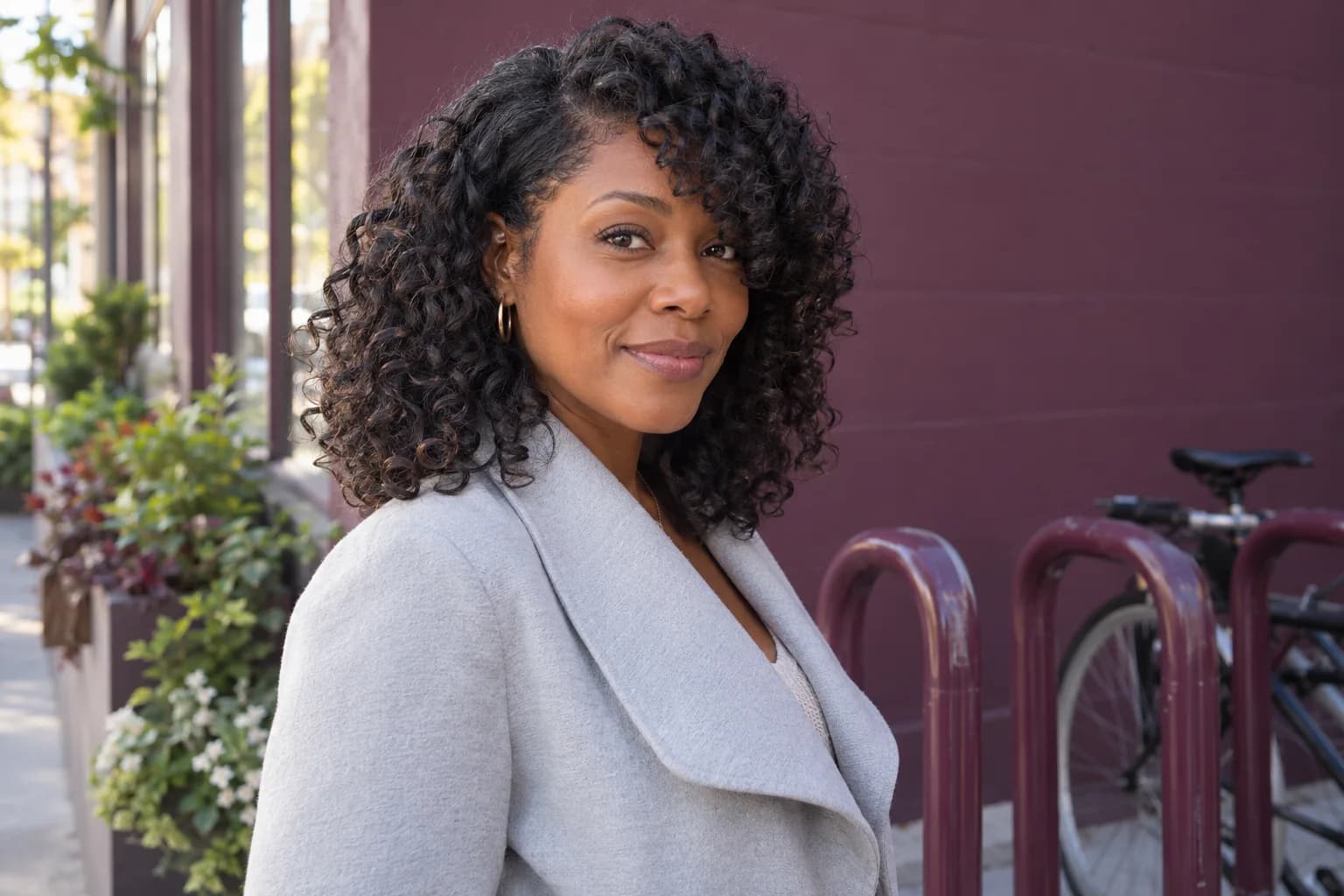
Use a preview to compare coverage, not to approve the cut
Once direction and endpoints are clear, an optional Hair Muse comparison can help you describe how much forehead coverage you prefer. Start with one clear, evenly lit portrait and compare a small number of available fringe styles. Keep the original beside them. If the available choices do not show the one-sided shape you mean, use suitable salon references instead of treating the nearest option as an exact match. Change one visual question at a time: less or more coverage, not fringe, color, total length and texture together. A simpler comparison makes it easier to explain what you are actually choosing.
HairChapter and Hair Muse share a publisher. Hair Muse is free to download; some uses or features may require in-app purchases. Its previews are planning aids, not evidence of your growth direction, dry endpoints, comfortable eye clearance or the feasibility of a particular cut. They do not predict real texture or salon results. Use the official App Store invitation here only if that visual comparison would help. There is no need to generate a perfect portrait before booking. Save one preferred reference and one less-covered alternative, then annotate the difference in words so the professional can evaluate it on your actual hair.
Check the sweep with your ordinary accessories and routine
Bring your everyday glasses to the appointment if you wear them. Check the hair near the upper rim and temple arms while looking down as well as forward. You are not asking a picture to certify comfort; you are giving the stylist a real object to consider. Think about work, reading, exercise and the moments when you want hair off your face. A longer sweep can offer a fastening option, but that depends on which pieces retain enough length to reach the clip. Ask to see the planned fallback rather than assuming every long-looking fringe can be tucked behind an ear.
Define your normal finish honestly. If you air-dry, say that before a polished blow-dried reference becomes the expected everyday result. If you use heat, ask for the simplest suitable method and follow the tool’s safety instructions; this is not a universal temperature or technique guide. Do not buy several styling products in advance to compensate for an unresolved haircut brief. Ask which small adjustment would matter on your own hair and which parts can be left alone. A manageable fringe is one whose ordinary compromises you accept, not necessarily the one that looks most controlled immediately after professional styling.

Translate the preferred image into a short salon agreement
Use three instructions: the side toward which the fringe should fall, the two dry endpoints, and the front section that must remain available for your fallback. Add one limit, such as no further widening without checking with you. Ask the stylist to repeat the intended shape and explain any conflict with existing length, texture or growth direction. You can then approve an achievable alternative before the irreversible step. Bring front and side references, but keep the written brief compact enough to use in conversation. A dozen saved pictures with different diagonals can be less useful than two well-chosen examples with clear annotations.
Return to the optional Hair Muse comparison only to explain the visual preference you already identified, such as less coverage near one eye. Keep the original photo visible and make clear that the preview is not a cutting pattern. The professional needs to translate that preference into your real dry shape. Before leaving, look at the result with your glasses if relevant and without holding the fringe in place. Ask how to manage the preferred fastening and what would justify a follow-up adjustment. Do not request repeated shortening merely because a generated image looks tidier than hair moving in ordinary life.
Set a maintenance trigger and protect your exit option
Choose what would actually prompt a trim: the shorter end changing shape, the longer section reaching an inconvenient place, or the diagonal no longer sitting as you prefer. Ask the salon what a fringe-only appointment includes and whether it would alter the side connection. There is no fixed schedule that suits every person wearing side bangs. Your tolerance for movement matters. If you like the softer, longer version, you may not want the exact fresh-cut line maintained. Make that preference explicit so an upkeep visit does not automatically restore a shorter starting point you were beginning to enjoy.
If you later grow the fringe out, agree which pieces will be left alone and which connections might need a small professional adjustment. Do not repeatedly shorten the whole front in the name of blending if your aim is to retain more length. Temporary fastening can help during an awkward stage, but it is not an exact timeline or a guarantee of immediate tucking. Keep a record of what worked: preferred direction, comfortable endpoints and the section you would not widen again. Those details remain useful even if the next cut is different. The successful decision is a clear, workable agreement, not permanent loyalty to one fringe shape.

Three terms that make this conversation clearer.
You do not need to prescribe technique. Use these words to describe the visible structure, name the behavior you want, and ask what your stylist would adapt.
Fringe / bangs
Hair intentionally sectioned and cut to live around the forehead, brows, eyes, or upper face. Fringe and bangs refer broadly to the same idea; regional language differs, while section width, density, dry length, and growth patterns determine the real behavior.
SAY IT IN THE CHAIR“Please show me how much hair will enter the fringe and where the shortest point will sit when dry.”Open full definition
Growth pattern
The direction hair naturally leaves the scalp and moves through areas such as the front hairline, crown, nape, and around the ears. Cowlicks, whorls, and directional changes can alter how short sections lift, split, or settle.
SAY IT IN THE CHAIR“Can we look at the front and crown dry before choosing the shortest length?”Open full definition
Face-framing layers
Shorter pieces concentrated around the front of a haircut to create movement or emphasis near the face. The first dry landing point, section width, part, and connection into the remaining length determine whether the frame feels subtle, dramatic, or fringe-like.
SAY IT IN THE CHAIR“Keep the shortest piece at this point and enough length for every front section to tuck back.”Open full definition
Turn this guide into a decision.
Three honest answers are more useful than ten additional reference photos. Your responses stay on this page and can be changed at any time.
- 01Do you know the shortest dry point you are comfortable wearing?
Decide where the center and outer corners may land before discussing the fringe name.
- 02Have you named the boundary you do not want traded away?
Examples: tie-back length, full ends, an open forehead, dry length, or support for natural texture.
- 03Does the plan fit your real styling and maintenance rhythm?
Count ordinary mornings, fallback styles, trim frequency, and the way the shape is likely to grow.
The short answers.
Are side-swept bangs the same as curtain bangs?
No. A side-swept fringe is arranged mainly toward one side; curtain bangs open toward both sides. A photo can blur the distinction. Show the direction and both dry endpoints instead of relying on the name alone.
Can I change the direction after cutting?
You may be able to style the front differently, but a cut designed around one direction need not look equivalent when reversed. If changing sides matters, discuss that requirement before agreeing the shorter end and side connection.
Do side bangs work with curls?
They can be discussed in your natural texture, but a smooth diagonal reference does not predict the arrangement of your curl groups. Ask for an assessment of their resting dry shape and the upkeep you are willing to do.
Should I choose longer bangs if I wear glasses?
Not automatically. A longer piece may reach the frame or eye, while a shorter piece may lose a fastening option. Bring your glasses and decide together how the dry fringe should sit around the actual rim and temple arms.
Can a preview tell me the exact length to request?
No. Use it to express a visual preference for coverage and direction. A stylist must assess real length, texture and movement, then agree dry endpoints with you. Keep the original photo and an alternative with less coverage available.
How this guide was built.
HairChapter separates haircut structure from styling, trend names, and medical claims. Our recommendations are decision tools, not universal rules: a stylist should adapt the direction to your starting length, density, pattern, condition, growth habits, and normal routine.
We do not claim that a photograph or AI preview can predict a finished service. Sudden shedding, patchy loss, scalp pain, persistent irritation, or an unexplained change in density belongs with a qualified medical professional—not a haircut guide.
A reference for the haircut vocabulary
- L’Oréal Paris — fringe-type definitions The definition of a diagonal, one-sided fringe and its distinction from a two-sided curtain shape. Face-shape rules, product claims and fixed maintenance intervals are not adopted.