
A bowl cut is an outline, not an instruction to shave
A bowl cut puts a rounded, cap-like outline at the center of the haircut. The fringe and sides relate to that overall edge rather than functioning as unrelated pieces. What happens underneath can vary considerably. There may be a soft transition, visible short hair or a much stronger separation. Decide whether it is the rounded shape, the graphic boundary or the exposed lower area that attracts you. Those are different requests. Revlon Professional describes several interpretations of the cut; its examples establish that the name covers variations, not that one version will suit every person or require no effort.
Begin by covering the lower section of your reference photograph with a finger. Do you still like the top shape? Then look only at the hair below the edge. Would you willingly wear that degree of shortness? If your answers differ, keep the outline you like and discuss a different lower finish. The word modern does not resolve this choice. Neither does calling the cut soft. Ask the professional to identify the retained top, the boundary and the lowest section on your own head before agreeing to any cutting. No household bowl or home-cutting template is involved.
Trace the edge from forehead to the back
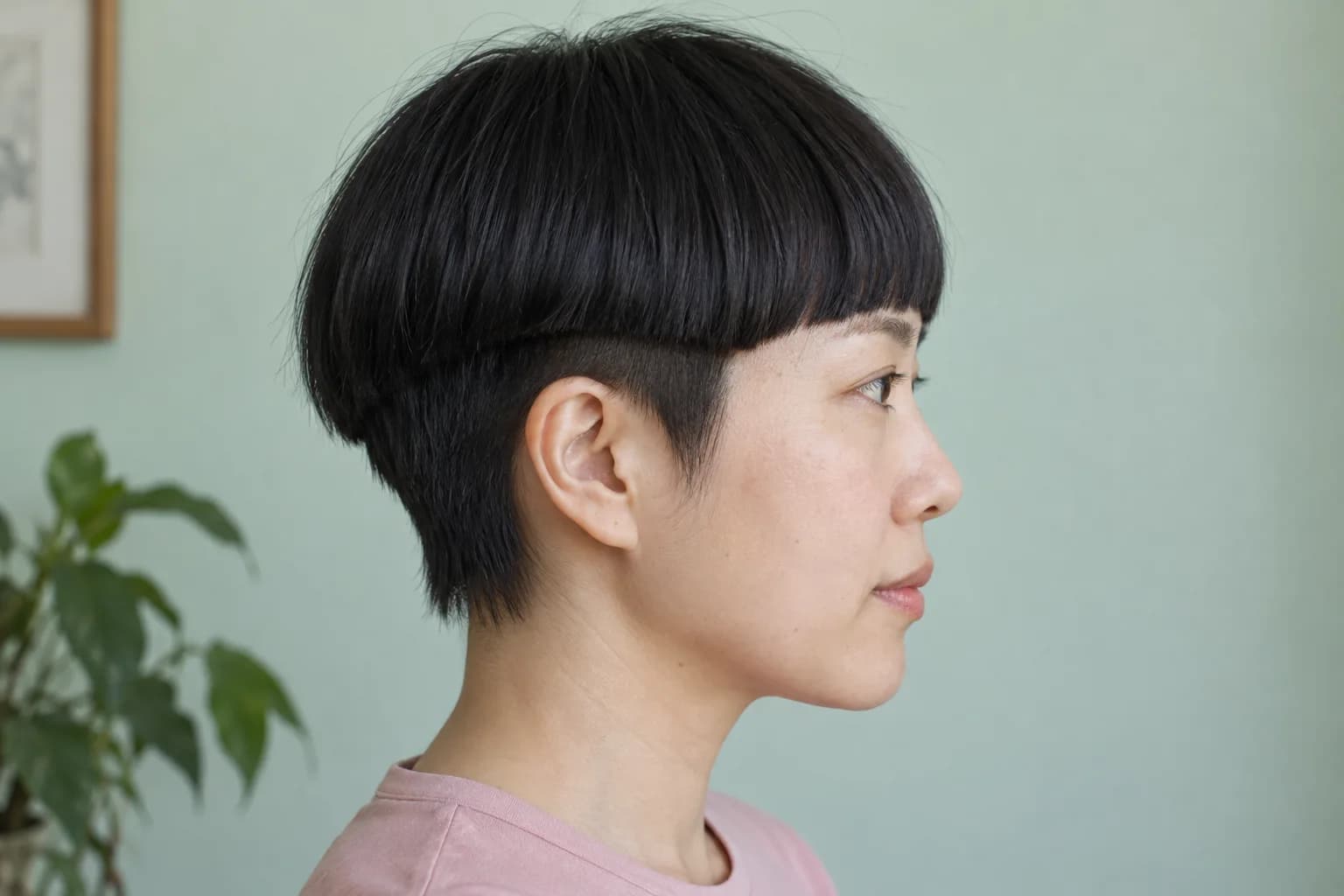
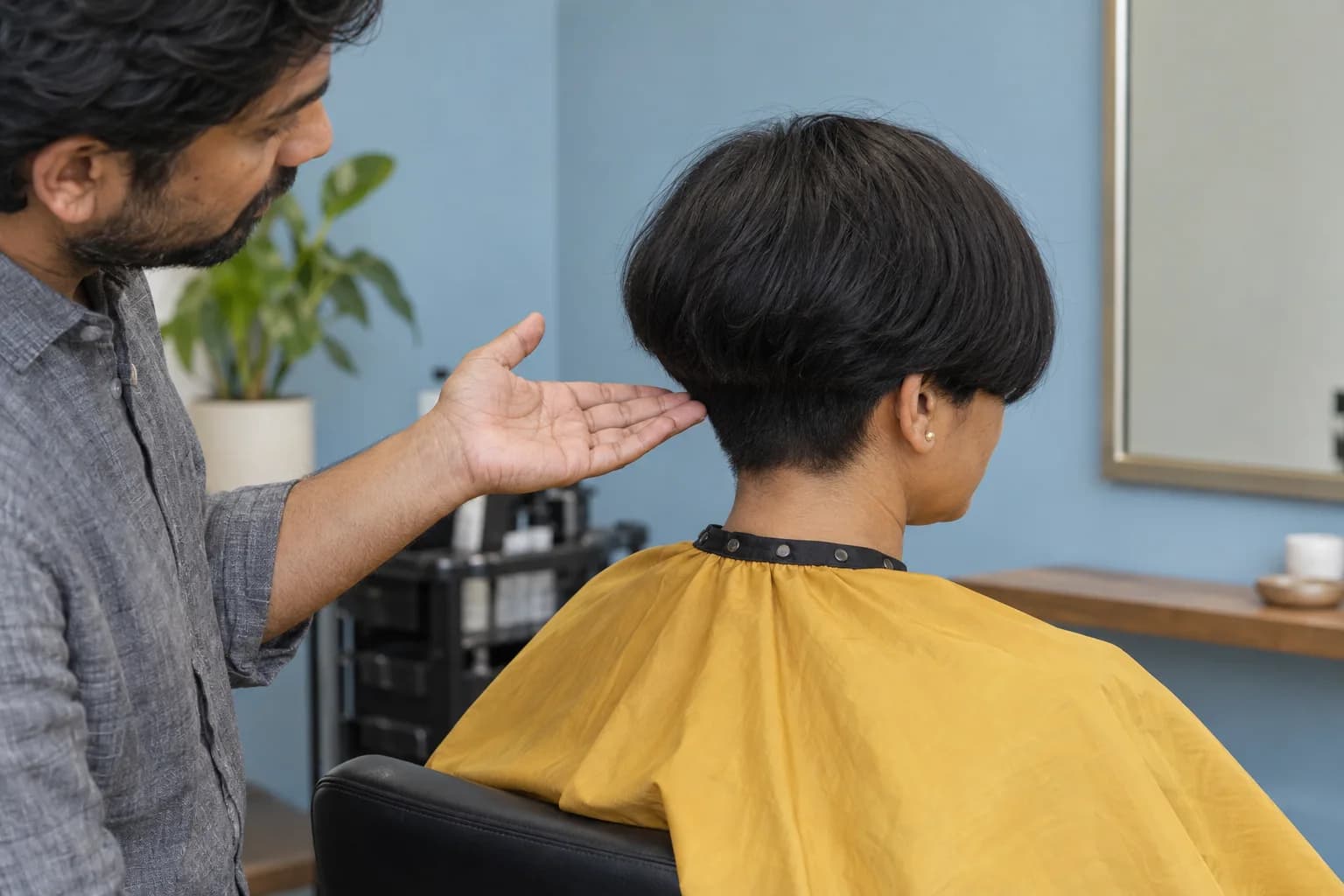
A front portrait can make this haircut look like a strong fringe with ordinary short sides. The defining question continues around the head. Where does the cap pass the temple? How much of each ear is exposed? How high does it sit at the back? Bring a genuine side and rear reference where possible, ideally of the same haircut rather than three unrelated models. Explain whether you like a continuous graphic line or a softer impression of rounding. A visibly curved silhouette does not require every individual end to lie on a perfect horizontal line in ordinary movement.
Ask the stylist to indicate the edge with your head upright and your hair resting naturally. Check both sides. An ear tuck changes what is visible, so show the position you normally use rather than holding everything forward for the consultation. If you wear glasses, put them on and notice which pieces meet the arms; if that is irrelevant, do not invent another requirement. Choose the edge you actually want to see, not the most dramatic version in your saved folder. A little more retained coverage can be a deliberate design choice rather than an unfinished approximation.
Agree the lower length independently
The hair below the cap determines much of the contrast. Ask for the shortest finish to be shown and described separately from the upper edge. Visible scissor-cut hair, a closer clipper finish and exposed skin are not interchangeable. A sharply separated top does not automatically authorize shaving the lower head. If a stylist proposes an undercut, clarify its area and what will be visible when the top moves. You can accept it, reduce it or choose a different transition. The useful discussion is not which tool sounds modern; it is how much hair remains and where.
Consider the commitment of two lengths growing at once. A long upper section cannot instantly replace a lower area that has been taken very short. If you later want a softer connection, you may need to tolerate an interim outline while that lower hair gains length. Ask which sections would need to grow and which could be adjusted without resetting them. If that prospect already feels unacceptable, start with a less extreme lower finish. Do not approve a high-contrast version only because you assume the cap will always conceal it. Movement, a different part and your own handling can reveal more than a still picture.
Keep the fringe comfortable without breaking the plan
A substantial fringe often makes the rounded shape immediately recognizable, but it still has to function near your eyes. Set a dry resting endpoint and say whether you expect to push it aside, lift it or wear it down. A fringe that looks excellent while carefully separated may feel very different as one continuous section. Show any familiar growth direction or area that opens by itself. Ask how the professional would adapt that behavior, rather than assuming a strong edge can make every strand obey. You are choosing a wearable front, not signing up to correct it throughout the day.
If the fringe needs to be shorter than the sides, discuss how those parts will meet at the temple. If you prefer an open forehead most days, ask whether another rounded short cut would express your goal more honestly. There is no benefit in keeping a label while hiding the detail you dislike. Avoid adding a second dramatic change, such as a much shorter fringe, simply because it appears in the reference. Specify the forehead coverage you consent to now. It is reasonable to keep more length initially, provided you understand that the first version will have a different balance.


Use texture and density to adjust the outline
Straight hair can reveal a precise boundary clearly, but that does not make all straight hair behave alike. Notice whether the crown separates, the sides press flat or the ends turn after sleep. Waves and curls can make the outline appear softer or change its dry position. Ask for an assessment in the texture you intend to wear. Do not convert a stretched curl into a guaranteed dry measurement. A rounded haircut can be designed around movement, but a photograph cannot tell you how the exact edge will settle on your head. Discuss the shape rather than a universal hair-type permission rule.
Also separate strand fineness from how much hair is present. If the edge already looks sparse in some areas, ask how the proposed outline preserves a coherent finish without promising extra density. If the cap feels heavy, identify the particular area that concerns you before requesting extensive thinning. Removing weight everywhere may change the very boundary you wanted to keep. You do not need to prescribe a cutting method; ask the stylist to explain the likely trade-off. A softer, interrupted-looking edge and a dense graphic line are both possible preferences, but they should not be treated as identical outcomes.
Give the cut an ordinary-day fallback
Before booking, describe the routine you will realistically perform after washing and after sleeping on the haircut. A smooth reference may involve deliberate drying even when it looks casual. Ask for a demonstration with the tools you already use, and say if daily straightening is not an option. The target is an acceptable resting outline, not a perfect imitation of the salon finish. Let the professional explain which front or crown area may need attention first. If the answer involves more work than you want, adjust the precision of the design instead of assuming a product purchase solves the mismatch.
Think about a typical day in sequence: putting on glasses, a commute in wind, work, exercise and the evening. Do you need the front held away, the ears uncovered or a cap that tolerates being disturbed? A short rounded cut will not give you a full ponytail fallback. Discuss a small clip or another comfortable arrangement only if it suits the retained lengths. If you use a hat or helmet, explain the normal contact and how much reshaping you are willing to do afterward. Do not alter protective equipment to preserve a hairstyle. The haircut needs to fit your life, including the days it looks less controlled.

Use an optional preview for proportion, not cutting geometry
If the remaining question is whether you like a compact rounded silhouette near your face, Hair Muse can provide optional visual planning. Start with one clear, evenly lit portrait and compare only a few available short styles. Do not assume an exact bowl variation or a separate lower-section editor exists. Keep color and other distractions stable where possible, then write down what you prefer about coverage or fullness. HairChapter and Hair Muse share a publisher. The app is free to download; some functions or usage may require in-app purchases. The official App Store invitation earlier on the page is optional.
A preview cannot establish a cutting line around the whole head, inspect your actual density or determine an appropriate shortest lower length. It does not guarantee real hair behavior, chemical color results, exact fit, salon feasibility or the finished result. Bring an unedited current photograph and actual side and back references as well. If a saved Hair Muse comparison helped, explain the single proportion it clarified; do not hand it over as a technical diagram. You can reach the same decision with a consultation alone. The independent brief remains the cap boundary, lower coverage, comfortable fringe and amount of daily adjustment you accept.
Decide whether the next visit maintains or softens the cap
A crisp outline and a softer grow-out require different decisions at the next appointment. If you want to maintain the cut, identify the first change that bothers you: fringe near the eyes, a lower section losing contrast or a cap that feels wider. Ask what needs reshaping rather than automatically restoring every area to its shortest starting point. There is no reliable universal interval for all versions and all heads. Plan the review around the actual shape and your tolerance. A small front adjustment does not necessarily require another large shortening underneath; confirm the scope before the service begins.
If you are growing away from the shape, tell the stylist before the clippers or scissors appear. Name the lower lengths that should now be left alone. You may accept a temporarily less graphic outline or discuss limited blending as the sections approach each other. Do not repeatedly recreate the shortest area while expecting it to catch up. Before leaving, view the front, profiles and back without holding the hair into place. Confirm what was preserved, what changed and what you will do after the next wash. A successful bowl cut is a shape whose boundaries you chose and whose compromises you understand.
Three terms that make this conversation clearer.
You do not need to prescribe technique. Use these words to describe the visible structure, name the behavior you want, and ask what your stylist would adapt.
Perimeter
The outside boundary of the haircut: the line you read around the bottom, sides, and overall edge. A compact perimeter usually feels fuller and more controlled, while a broken or highly layered perimeter can feel lighter, softer, or more textured.
SAY IT IN THE CHAIR“I like the movement, but I want the outside edge to remain substantial when the hair is straight or air-dried.”Open full definition
Layer map
A plain-language way to describe where the shortest layers begin, how quickly they connect to longer sections, and where movement or volume is intended to appear. Two haircuts with the same overall length can feel completely different because their layer maps differ.
SAY IT IN THE CHAIR“Show me the shortest layer, where it connects, and how much weight remains beneath it.”Open full definition
Silhouette
The complete outside shape a haircut creates when viewed as a whole: compact, rounded, triangular, elongated, wide, narrow, or deliberately irregular. It is often the most reliable feature to compare before discussing small details or a polished finish.
SAY IT IN THE CHAIR“I want this overall shape, but I am open to changing the internal technique for my hair.”Open full definition
Turn this guide into a decision.
Three honest answers are more useful than ten additional reference photos. Your responses stay on this page and can be changed at any time.
- 01Can you point to the exact structural detail you want from this cut?
Name the shortest point, outside line, layer map, or placement of volume.
- 02Have you named the boundary you do not want traded away?
Examples: tie-back length, full ends, an open forehead, dry length, or support for natural texture.
- 03Does the plan fit your real styling and maintenance rhythm?
Count ordinary mornings, fallback styles, trim frequency, and the way the shape is likely to grow.
The short answers.
Does a bowl cut always need shaved sides?
No. Agree the upper outline and lower finish separately. Ask to see how much visible hair will remain underneath and whether the connection is soft or deliberately separated. A reference with an undercut is not consent to shave your own sides.
Can a bowl cut work with curls?
Discuss a rounded silhouette in your normal dry texture. Curls change where the outline appears and may not reproduce a smooth straight reference. Ask how the shape will be checked without stretching every section into an artificial position.
Is a bowl cut automatically low maintenance?
No. A precise edge or a fringe near the eyes may need more attention than the photograph suggests. Describe your actual drying routine and ask for an acceptable fallback, including the way the hair looks after sleep or wearing a hat.
What is different from a hime cut?
A hime reference usually emphasizes shorter side panels against retained long hair. This decision centers on a rounded cap around the head and the lower section beneath it. Show the outline rather than relying on labels when references overlap.
How do I grow out the shorter hair underneath?
Tell the stylist that the goal has changed. Identify the lower areas that must gain length and discuss only adjustments that support that goal. Expect an intermediate shape; a longer top cannot instantly replace a much shorter base.
How this guide was built.
HairChapter separates haircut structure from styling, trend names, and medical claims. Our recommendations are decision tools, not universal rules: a stylist should adapt the direction to your starting length, density, pattern, condition, growth habits, and normal routine.
We do not claim that a photograph or AI preview can predict a finished service. Sudden shedding, patchy loss, scalp pain, persistent irritation, or an unexplained change in density belongs with a qualified medical professional—not a haircut guide.
Professional context for the shape
- Revlon Professional — bowl cut variations Professional descriptions distinguish rounded outlines, texture and lower-section variations. Historical revival claims, product recommendations and cutting instructions are not adopted here.