
Start a razor cut conversation with the change you want
A razor cut can suit a deliberate wish for softer transitions or more separated ends. It is not an automatic route to extra volume, less frizz or easier mornings. Culture Coiffure describes the razor as a tool that can combine shortening with texturizing. The useful question is whether your stylist plans to change length, remove substance from a section, or do both. Ask them to show the difference on your own hair. You can agree to soften one edge without agreeing to razor work throughout the haircut. A shape may be established with scissors and refined selectively afterward.
Begin with something you can observe: the face frame falls too heavily, the ends feel too compact, or one connection looks rigid. “Make it modern” does not identify a place or an amount. Say what already works and should remain. Perhaps you like the full bottom outline but want a softer front. Those are separate decisions. Consent to changing the front does not automatically include the back or every end. Ask whether a different distribution of length could solve the problem without further thinning. The proposed tool should follow the agreed shape and protected areas.
Scissors and razors are not fixed opposites
Scissors can create a clear line, but they can also develop movement and transitions. Seeing a razor on the trolley does not tell you how much hair would be removed. In TOP HAIR, educator Matthias Bugge discusses different cutting tools and their professional application. For a client, that is a reason to ask about the intended effect rather than choose a technique by reputation. Try: “What change would this make here, and why is that useful?” An answer should describe your hair and your goal. “We always do this” does not explain either benefit or limit.
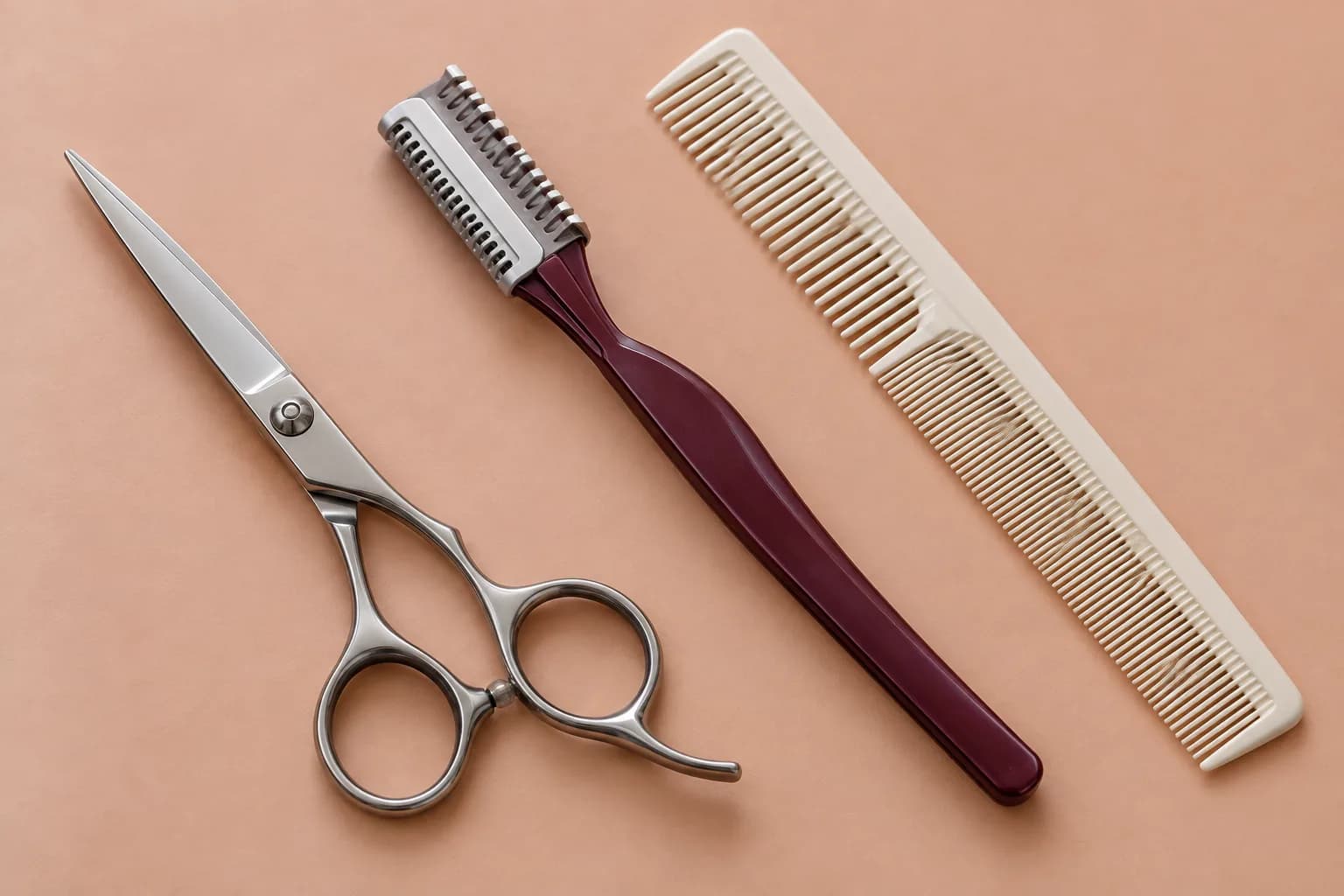
A straight cutting shear, a toothed blending shear and a haircutting razor are different tools. Razor work in the lengths is also different from shaving skin at the neckline or using a separately branded cutting system. If the proposal comes with a special technique name, ask what will actually happen. You do not need to demonstrate technical knowledge. You need agreement on length, remaining fullness and the visible edge. A combination of tools may be appropriate, and a scissors-only approach may also be appropriate. Neither choice proves that a haircut is inherently newer or more skilled.
Check end fullness as well as individual hair thickness
Fine strands and a small number of strands are different characteristics. For this decision, also consider how much hair reaches the lower outline. Dense hair can still have heavily worked, noticeably thin ends. Look at your dry lengths against a plain background without gathering them tightly or fanning them out. Where is the shape continuous, and where do individual pieces separate? This observation is not a diagnosis. It helps you name a priority: preserve existing substance, lighten one heavy area, or intentionally accept a feathered edge. Equal outer length alone does not guarantee the same visual fullness.
If the last few inches already look transparent and that bothers you, more thinning there may conflict with your goal. Ask whether a clearer basic line or a different length arrangement would help first. With abundant hair, targeted work inside a heavy section may be a more relevant discussion than thinning every end. Have the proposed area shown on your head. When nobody can identify where the problem sits, it is harder to explain why removing more material would help. Starting cautiously does not require a motionless haircut; it protects the fullness you actually want to retain.
Use your ordinary dry texture as the reference
Show how you normally wear straight hair, waves or curls. A smooth blowout tells the stylist less about your priorities if you usually air-dry. With curls, consider which hairs form a dry curl together and how shorter pieces would sit within it. Rather than accept “a razor always works” or “a razor never works,” ask which section would change and how you will review its dry fall. If the professional has not seen your usual texture, an extensive texturizing decision can be difficult to assess. Bring a recent ordinary-light photo if the appointment starts with a different finish.
Describe earlier experiences precisely. Were the ends too sparse, did shorter surface pieces stick out, or did the front become harder to group? That is more useful than saying only that a razor gave you a bad haircut. Placement, amount and styling may all have contributed. Mention color or other chemical treatments so the stylist can assess the starting condition. A tool name cannot establish suitability for your present lengths. If the explanation remains uncertain, choose a smaller change or postpone extra texturizing. You do not need to accept an unclear intervention to be an agreeable client.


Agree a small first version with protected boundaries
A workable plan names the section, the desired effect and the protected boundary. The face frame might become softer while the deepest outline stays continuous. One heavy connection might be refined without shortening the whole crown. Ask the stylist to show which hairs would be affected. A limited first version is not a reversible trial: even a small amount removed is gone. It does limit the scope of your consent. If length retention matters, include the shortest acceptable falling point, not only the total length at the back. The front and lower outline may need separate limits.
Build in a review before more hair is removed. Look at the section in your normal part and as close as practical to your everyday finish. Ask whether the original heavy area remains or whether the remaining difference comes from styling. That separates another cutting decision from the wish for a perfect salon photograph. A useful boundary could be no surface work, no thinning in the final inches, or no shortening in the area tucked behind your ear. The appropriate boundary depends on your goal. Keep the agreement understandable rather than disguising it as instructions for a specific hand movement.
Discuss everyday effort and growing out separately
Softer ends may give exactly the relaxed appearance you like without making every morning easier. Ask for the simplest realistic finish and explain which products and drying steps you actually use. More separation might work with that routine, but it does not replace a continuous outline if that is your real preference. A haircut that looks convincing only with extra heat is not automatically low maintenance. At the end, ask to see the form before strong waves or a very smooth finish conceal differences. Assess the routine you would repeat, rather than only the photograph taken in the chair.
Growing out involves more than increasing the longest outer length. Shorter pieces also need to rejoin a shape you like. Restoring fuller ends may conflict with keeping maximum length immediately. Before the cut, ask which area would have the longest transition. There is no dependable number of weeks for every head of hair. Occasional photographs in the same ordinary finish can show whether the same area still bothers you. At a later appointment, state whether the goal is maintaining the textured effect or rebuilding fullness. Automatic repeat thinning can work against the second goal even if the hair briefly feels lighter.

Use a preview for visible direction, not tool selection
If a compact outline and a softer finish are difficult to describe, Hair Muse is an optional visual planning aid. Compare a small selection of available hairstyles on your own evenly lit portrait, keeping length and color similar where possible. Note whether you prefer movement near the face or a quieter bottom line. Hair Muse cannot determine whether a pictured style was cut with a razor or scissors. A preview does not measure remaining end fullness or the real cohesion of curl groups. Keep the image as a description of a visible preference, then discuss its execution with a professional.
HairChapter and Hair Muse share a publisher. Hair Muse is free to download; some uses or features may require in-app purchases. The official App Store invitations here are optional. Hair Muse previews do not guarantee actual hair behavior, feasibility, chemical color results or a salon outcome. If the available looks change length, color and styling together, the comparison does not isolate your tool question. Two annotated real references and a picture of your current dry ends may then communicate more than an attractive simulation that differs from your plan.
Turn the decision into a practical salon agreement
Summarize the request in ordinary language: “I want less rigidity beside my face, but not a thinner bottom edge. I usually air-dry. Please explain the area you would work on, and let us check the shape before thinning more.” Add the minimum acceptable length and a relevant previous experience. This establishes how you will judge the result together; it is not a demand for a particular blade movement. If the effect requires crossing a boundary you want to keep, the plan needs to change. An explained refusal supports a clearer decision than agreement without understanding what will be removed.
Finally, check the front, profile and back while standing or sitting naturally. Do the ends separate where you agreed? Do protected sections still look full? Can you repeat the simplest styling method? Ask for a record of the areas worked so the next visit does not automatically remove the same amount. After ordinary washes, observe the shape without the salon finish. If dissatisfied, describe the specific difference and discuss it before cutting more yourself. The goal is a comprehensible change whose consequences you accept, rather than loyalty to one cutting tool.
Three terms that make this conversation clearer.
You do not need to prescribe technique. Use these words to describe the visible structure, name the behavior you want, and ask what your stylist would adapt.
Consultation brief
A short, usable description of the result you want and the reality it must support. The strongest brief combines one structural change, one non-negotiable boundary, your normal styling routine, and a question that invites the stylist to adapt the plan.
SAY IT IN THE CHAIR“I want to change this, keep this boundary, and make sure the result still works when I style it this way.”Open full definition
Baseline
The lower edge or foundation of a haircut, especially visible in bobs and other compact shapes. A strong baseline can make the ends read as fuller and more graphic; a softer or broken baseline can make the outline feel lighter and less exact.
SAY IT IN THE CHAIR“I want the bottom line to feel complete, but not so sharp that the grow-out looks abrupt.”Open full definition
Maintenance window
The period during which a haircut still performs the job it was designed to do before a particular detail needs reshaping. The true window is set by the first meaningful change—often a fringe, nape, perimeter, crown, or loss of internal balance.
SAY IT IN THE CHAIR“Which detail will stop working first, and what is a realistic return window for that part?”Open full definition
Turn this guide into a decision.
Three honest answers are more useful than ten additional reference photos. Your responses stay on this page and can be changed at any time.
- 01Can you state one clear priority for this appointment?
A useful priority is specific enough to protect when the reference needs adaptation.
- 02Have you named the boundary you do not want traded away?
Examples: tie-back length, full ends, an open forehead, dry length, or support for natural texture.
- 03Does the plan fit your real styling and maintenance rhythm?
Count ordinary mornings, fallback styles, trim frequency, and the way the shape is likely to grow.
The short answers.
Does a razor cut always mean thinning?
Not necessarily. A razor can work on length and transitions with varying texturizing effects. Ask whether substance will be removed and from which section. The tool name alone describes neither the amount nor the resulting outline.
Can I agree to a razor cut on fine hair?
Have the stylist assess density and existing end fullness first. If transparent ends already bother you, protecting the outline should be a priority. Strand fineness alone does not establish suitability; the goal, location and amount of work need to agree.
Are razors always unsuitable for curls?
A general prohibition does not describe your particular hair. Discuss dry curl groups, previous experiences and the proposed change. If the explanation does not account for your natural movement, you can decline more texturizing and choose a smaller adjustment.
Can a photograph reveal a razor cut?
Not reliably. Styling, density, movement and lighting change how ends appear. Describe the visible shape you like instead of inferring the cutting tool. A generated preview cannot prove a technique either.
How can my ends become fuller after texturizing?
Agree a fullness-building plan rather than repeat thinning. Depending on the starting lengths, this may involve waiting or gently adjusting the outline while giving up some immediate length. No fixed transition time is guaranteed; ask which section has the longest way to grow.
How this guide was built.
HairChapter separates haircut structure from styling, trend names, and medical claims. Our recommendations are decision tools, not universal rules: a stylist should adapt the direction to your starting length, density, pattern, condition, growth habits, and normal routine.
We do not claim that a photograph or AI preview can predict a finished service. Sudden shedding, patchy loss, scalp pain, persistent irritation, or an unexplained change in density belongs with a qualified medical professional—not a haircut guide.
Professional background
- Culture Coiffure — razor cutting Professional training vocabulary connecting cutting and texturizing. Broad volume or maintenance promises are not adopted here.
- TOP HAIR — educator Matthias Bugge on cutting tools Different professional tools and their skilled use; not a DIY cutting guide or a universal suitability rule.