
Start a split ends trim with a specific problem
A split ends trim should start with an assessment of actual ends, not an automatic number of inches. Tell the stylist whether you are seeing branching tips, an uneven bottom outline, tangling in one area or simply a rough-feeling finish. Those observations are useful, but they are not interchangeable. Dryness and flyaways do not prove that every shorter strand is damaged. Bring the hair in the texture you usually wear, following the salon's preparation instructions, and show where the problem is most noticeable. Ask what the professional can see before agreeing either a small maintenance trim or a larger change.
Your practical goal matters just as much as the observation. You might want ends that are easier to manage while preserving a ponytail, a more defined bottom line, or removal of as many visibly split tips as possible. These goals can lead to different amounts of cutting. Write down which comes first and which is negotiable. For example, retaining a particular fastening length may take priority over removing everything in one appointment. That is a real trade-off to discuss, not permission for the stylist to promise complete removal without shortening. Keep the first decision focused on today's cutting scope.
Distinguish a visible split from a dry-looking finish
A clearly divided tip is different from an end that feels rough or looks less polished after washing. Wella's professional guidance distinguishes dry ends that may feel better with care from true split ends that are removed by trimming. Use that narrow distinction, not the surrounding product advertising, to frame the conversation. A smoother appearance after conditioning is not proof that a visibly divided fiber has become intact again. Equally, do not conclude that every textured or uneven strand must be cut because it does not resemble a glossy reference photograph. Ask for an assessment of the actual section that concerns you.
Look at a small loose section in ordinary daylight if it helps you explain the problem. Do not repeatedly pull apart tips, break off individual ends or keep searching until you feel compelled to shorten everything. A phone photograph has limited detail and may exaggerate wispy ends against a bright background. It can record the location, not establish a diagnosis or the correct cutting line. If your concern is sudden widespread breakage, scalp discomfort or another change beyond ordinary end maintenance, a haircut guide cannot explain the cause. Seek appropriate professional advice rather than trying to solve an unexplained problem with increasingly large trims.

Ask which ends a perimeter trim will actually reach
A perimeter trim changes the bottom outline of the hair. It does not automatically reach every end in a layered cut, a face frame or a shorter front section. Ask the stylist to separate those areas when describing the plan. If only the longest line is trimmed, damaged tips elsewhere may remain. If shorter sections are also refreshed, their endpoints move too, even when the overall length changes very little. This is why the phrase 'only the ends' can produce a surprise: there are ends at several different heights, not one shared edge around the whole head.
Make a simple section-by-section agreement. Identify the bottom line, the existing layers and the front pieces you rely on for tucking or fastening. Ask which will be cut and which will be left alone. You do not need to name a cutting technique to do this well. You need to understand what length each intervention removes. If you are growing out layers, say so before the stylist refreshes them into a sharper pattern. Preserving a longer destination may be more important than making every short section look newly cut. Ask what remains imperfect under the smaller plan and decide knowingly.
Choose between targeted work, a trim and a shorter outline
Targeted removal of selected damaged tips, sometimes called dusting, is a different request from taking an even amount off the bottom. Service names vary, so ask what the salon means by the term and where the scissors would be used. Do not assume a named technique guarantees zero length loss, catches every split or suits all existing shapes. Selected ends are still shortened when they are cut. A conventional trim may give you a clearer outline but remove more of the longest length. A larger shortening can address a broader affected area while making a genuine haircut change.
Ask the stylist to show the smallest useful option and a more thorough option before choosing. Compare what each removes, what it leaves and what daily function it affects. If the more thorough line crosses your personal limit, you can accept partial improvement, discuss staged work or postpone the change. A staged plan means some affected ends remain for now; it is not a claim that they have been repaired. There is no universal centimeter allowance that settles this for every head. The visible condition, distribution of ends, existing layers and your consent determine the discussion, not an online promise of an invisible haircut.

Protect the lengths you use in real life
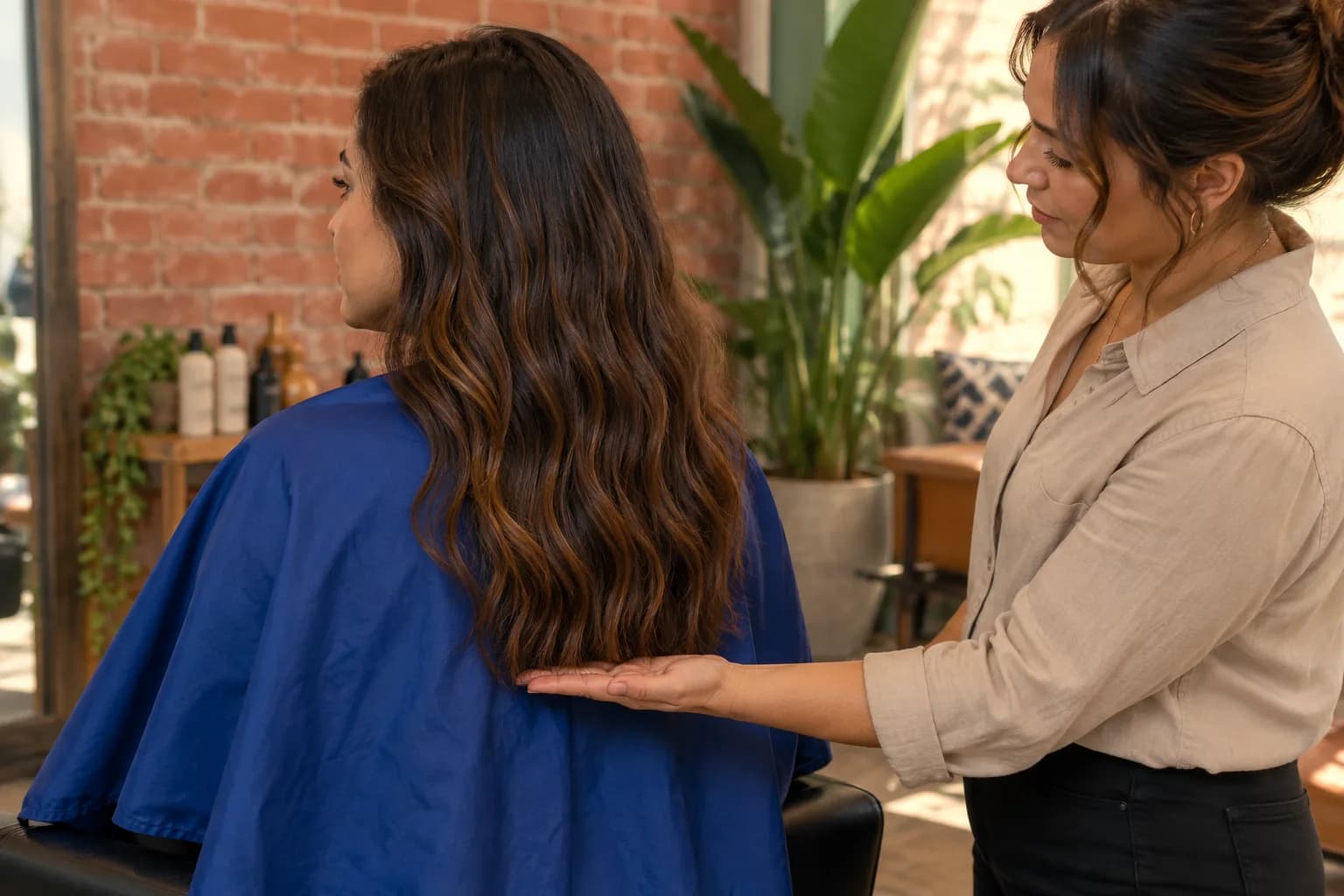
Show the stylist what your hair must still do after cutting. Try your normal ponytail, bun, ear tuck or loose finish before the appointment begins. Identify front pieces that just reach a fastening and layers that already escape it. A small amount removed from the bottom may not affect the front at all, while a small amount removed from a shorter section can change how you secure it. Agree those limits separately. If retaining them means leaving some affected ends, ask the professional to explain that compromise without treating your preference as a refusal to care for your hair.
With curls and coils, discuss the dry endpoint in the texture you intend to wear. A section held straight does not show its ordinary resting position. The stylist may choose an assessment and cutting method appropriate to the shape, but you can still ask how the proposed removal will be checked after the hair settles. Do not request a guaranteed amount of shrinkage or use a photograph to calculate it yourself. For fine-looking ends, also separate a sharper perimeter from added layers or thinning. A desire for a fuller outline does not automatically authorize removing internal weight or redesigning the front.
Use a stop-and-check agreement before more is removed
Before cutting, agree the first boundary in a way both people can see. Ask the stylist to indicate the proposed line on your hair, explain which sections it applies to and confirm that any additional shortening will require another conversation. Avoid relying only on a finger-width description when you are picturing different amounts. A visual indication and a written note are useful together. If the plan changes during assessment, pause and choose again. You are allowed to prefer a smaller intervention after hearing its limitations, or to authorize a larger one after seeing why it would be different.
At the review, check the front, sides and back in a relaxed position. If the hair is styled very differently from your everyday finish, ask how the retained lengths will sit when you use your usual routine. Explain a concern by location and behavior: a front piece no longer tucks, the bottom is shorter than the agreed line, or a section still tangles. Do not respond to every remaining irregular tip by consenting to another all-over shortening. First clarify whether the issue is a styling adjustment, an untouched section or the compromise you deliberately accepted. Further cutting should have a defined purpose.

Compare a shorter silhouette only if it is a genuine option
If the assessment suggests a more noticeable change than you expected, take time to decide whether that shape is something you want to wear. Hair Muse can be an optional visual planning tool for comparing broadly longer and shorter styles on one evenly lit portrait. Keep other variables stable and save a small shortlist. HairChapter and Hair Muse share a publisher; the app is free to download, while some functions or usage may require in-app purchases. The earlier App Store invitation is optional. You do not need a preview to approve a straightforward trim within a familiar outline.
A preview cannot inspect split fibers, locate damage, measure the amount that should be cut or establish a safe chemical service. It does not guarantee real hair behavior, exact fit, salon feasibility or the result. Use it only to express a silhouette preference when a substantial shortening is already under discussion. Take the original photograph and your written length boundary to the stylist alongside any selected image. A digitally tidy edge is not evidence that a tiny real trim removes every affected end. If you still prefer retaining the longer outline, say so and return to the smaller plan's actual limitations.
Plan the next review without promising perfect ends
After the cut, note what was removed, what was deliberately retained and how the ends behave after your normal washes. Ask for handling advice suited to your actual routine rather than purchasing a whole new system solely because the hair has been trimmed. Be gentle when detangling, avoid repeatedly tugging through the same snag and discuss unnecessary heat or friction with your stylist. Follow directions for any products you already use. These choices do not certify that splitting will never return, and a haircut does not explain every cause of breakage. The useful outcome is a manageable plan you can actually repeat.
Set the next review around the remaining problem and your preferred outline, not an arbitrary countdown. If some shorter ends were left untouched, include that in the next appointment brief instead of assuming the first service addressed them. If a saved Hair Muse comparison clarified a future shorter shape, keep it as a preference reference rather than a growth or repair forecast. You may continue with small trims, authorize targeted work or later choose a different length. The important distinction remains the same: improving today's finish, removing affected ends and changing the haircut are related decisions, but they are not identical promises.

Three terms that make this conversation clearer.
You do not need to prescribe technique. Use these words to describe the visible structure, name the behavior you want, and ask what your stylist would adapt.
Consultation brief
A short, usable description of the result you want and the reality it must support. The strongest brief combines one structural change, one non-negotiable boundary, your normal styling routine, and a question that invites the stylist to adapt the plan.
SAY IT IN THE CHAIR“I want to change this, keep this boundary, and make sure the result still works when I style it this way.”Open full definition
Baseline
The lower edge or foundation of a haircut, especially visible in bobs and other compact shapes. A strong baseline can make the ends read as fuller and more graphic; a softer or broken baseline can make the outline feel lighter and less exact.
SAY IT IN THE CHAIR“I want the bottom line to feel complete, but not so sharp that the grow-out looks abrupt.”Open full definition
Maintenance window
The period during which a haircut still performs the job it was designed to do before a particular detail needs reshaping. The true window is set by the first meaningful change—often a fringe, nape, perimeter, crown, or loss of internal balance.
SAY IT IN THE CHAIR“Which detail will stop working first, and what is a realistic return window for that part?”Open full definition
Turn this guide into a decision.
Three honest answers are more useful than ten additional reference photos. Your responses stay on this page and can be changed at any time.
- 01Can you state one clear priority for this appointment?
A useful priority is specific enough to protect when the reference needs adaptation.
- 02Have you named the boundary you do not want traded away?
Examples: tie-back length, full ends, an open forehead, dry length, or support for natural texture.
- 03Does the plan fit your real styling and maintenance rhythm?
Count ordinary mornings, fallback styles, trim frequency, and the way the shape is likely to grow.
The short answers.
How much hair must be cut to remove split ends?
There is no universal amount. Ask the stylist to assess where affected ends occur and show what a small trim removes versus a more thorough option. Agree retained lengths and any remaining compromise before cutting.
Can products replace a split ends trim?
Care can improve the feel or appearance of rough ends, but that is not the same as removing a visibly split tip. Discuss the actual condition with a professional instead of treating a smoother finish as proof of permanent repair.
Does dusting mean no length is lost?
No. Selected tips are shortened when cut, even if the overall outline changes little. Ask the salon which sections its service reaches, what it leaves and whether it suits your existing haircut.
Will trimming the bottom remove splits in layers?
Not necessarily. Layers and front pieces end above the longest outline. Ask for a separate assessment and cutting agreement for those sections, especially if you are growing them longer.
Can I keep my ponytail length?
Make that a clear boundary and try the fastening before cutting. The stylist can explain whether removing the affected ends conflicts with it. Keeping the function may mean accepting incomplete removal for now.
How this guide was built.
HairChapter separates haircut structure from styling, trend names, and medical claims. Our recommendations are decision tools, not universal rules: a stylist should adapt the direction to your starting length, density, pattern, condition, growth habits, and normal routine.
We do not claim that a photograph or AI preview can predict a finished service. Sudden shedding, patchy loss, scalp pain, persistent irritation, or an unexplained change in density belongs with a qualified medical professional—not a haircut guide.
Professional context for ends, not a cutting prescription
- Wella Professionals — dry ends and split ends The distinction between improving dry-feeling ends and removing visibly split ends by trimming. Product claims, temperatures and fixed routines are not adopted.