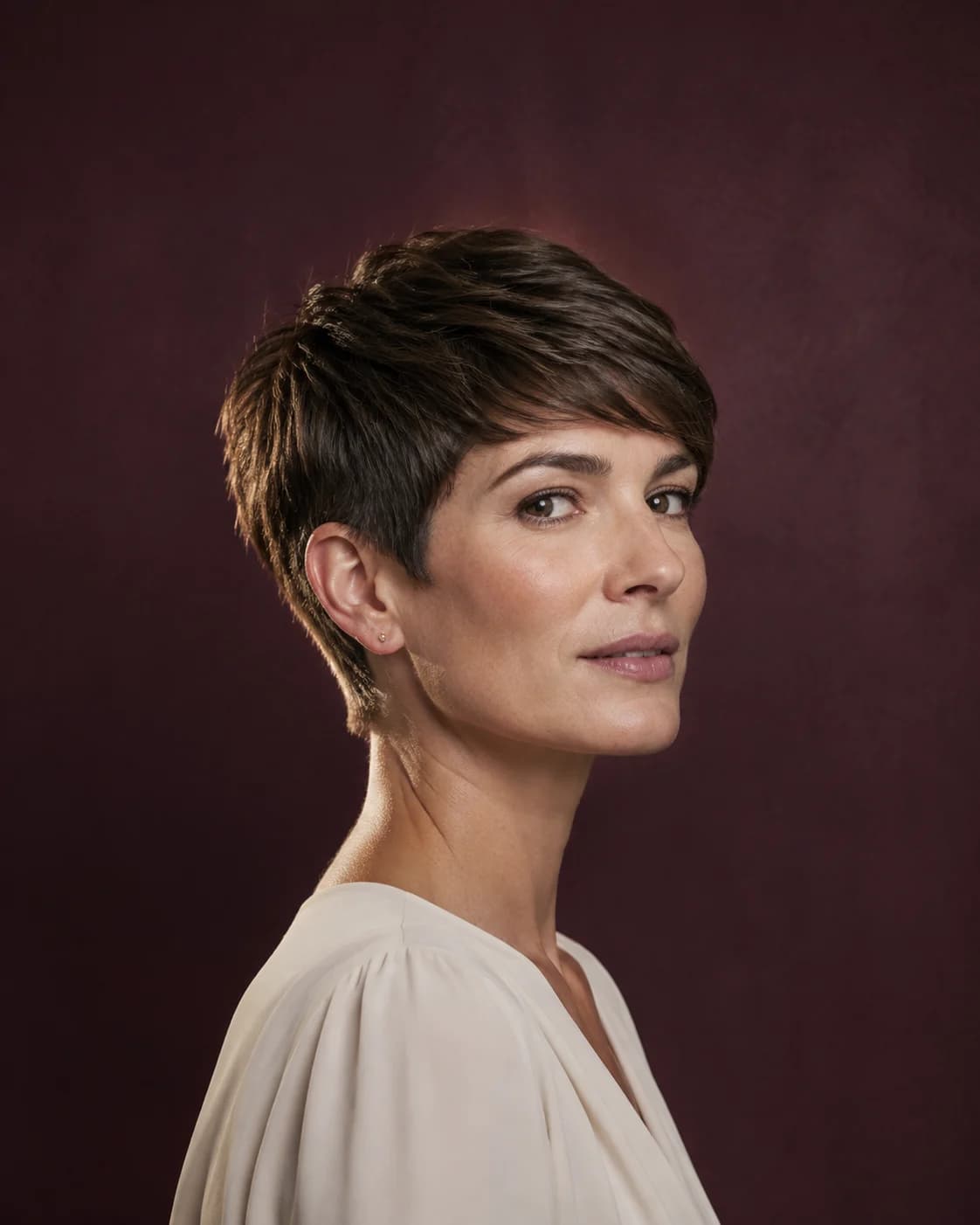
SHORT / HIGH UPKEEP
The long pixie
A short cut with enough length through the crown and fringe to change the finish. Its identity comes from several connected zones, not one outside line.
- Length
- Short
- Texture read
- Straight / Wavy / Curly
- Upkeep
- High
Updated 06 Sep 2026 · Haircut guidance, not a universal suitability rule · Hair Muse relationship disclosed
How we publishTHE EDITORIAL READ
See what the finished photograph can hide.
A long pixie is not simply a bob cut shorter. It is designed through separate zones: crown, fringe, temples, ears, sides, and nape. The relationship between those zones determines whether the shape feels sculpted, soft, directional, or disconnected.
The longer top creates useful flexibility, but it does not remove the commitment of a short outline. Ask which zone must stay neat for the cut to feel intentional and which areas can grow into a softer shape. That answer matters more than a single maintenance number.
THE CUT IN FOUR LINES
Read the architecture.
- 01 / Silhouette
- Sculpted around crown, ears, and nape
- 02 / Perimeter
- Broken into several short zones
- 03 / Movement
- Directed through the longer top
- 04 / Pressure point
- Cowlicks, exposed areas, product preference, and the stage when the ears begin to disappear.
THE ROUTINE TEST
How the look lives after the salon finish.
Use the timeline as a planning lens, then adapt it to your wash rhythm, weather, styling method, and the way your own hair changes between appointments.
Start at the roots.
Short shapes respond quickly to growth direction. Reset the crown and fringe while slightly damp, then use a small amount of product only where separation or control is needed.
Change direction deliberately.
Sweep the front, expose the ears, or add texture through the top. The longer sections should offer more than one believable arrangement.
Track zones separately.
The ears, nape, and crown do not lose shape together. A small perimeter cleanup may extend the useful life of the longer top.
MAKE THE IDEA YOURS
Adapt the direction without losing its point.
A reference is useful when you know which structural idea should survive and which detail can change for your texture, density, routine, or comfort level.
Keep the front and crown generous.
More length in the upper zones preserves styling options and creates a clearer route into a bixie or short bob if you decide to grow.
Let the cowlick set direction.
Build the fringe or crown around the way the hair lifts and separates instead of choosing a reference whose movement depends on the opposite pattern.
Choose connection over separation.
A softer, more connected layer map can settle with less deliberate piece-by-piece styling than a highly textured, fragmented finish.
THE FINAL CHECK
Is this the right trade-off?
- Choose it when
- You want a visibly short identity, enjoy changing the front or crown, and accept that several zones need periodic refinement.
- Reconsider when
- You prefer the outer perimeter to do the work, need dependable tie-back options, or want a single simple grow-out line.
SAY IT IN THE CHAIR“Which zones will grow out first, and how much length can we keep in the front?”