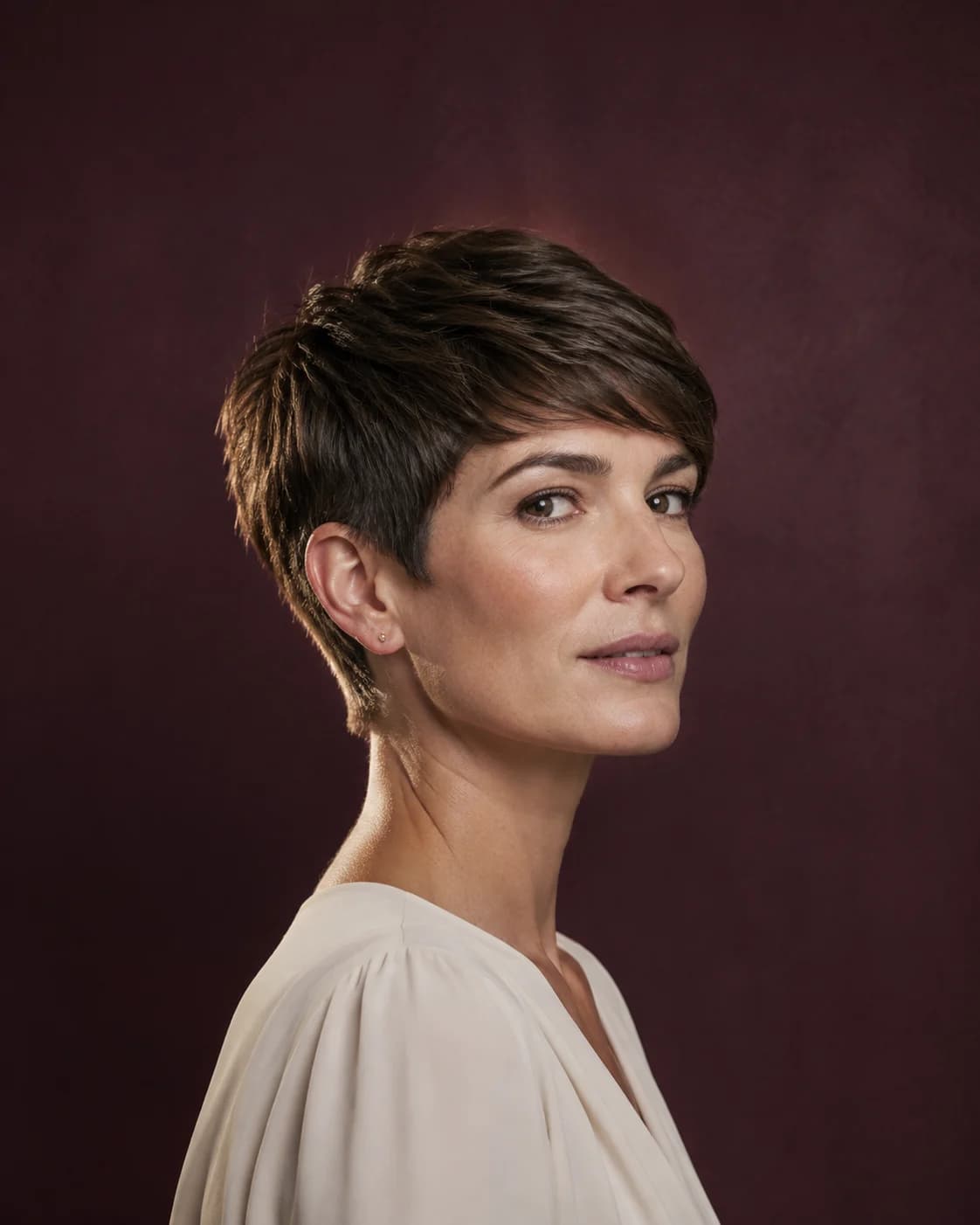
LONG / MODERATE UPKEEP
The low face frame
Long front pieces create movement around the cheek or jaw while keeping the forehead open. It is a useful first change when true fringe feels too committed.
- Length
- Long
- Texture read
- Straight / Wavy / Curly
- Upkeep
- Moderate
Updated 06 Sep 2026 · Haircut guidance, not a universal suitability rule · Hair Muse relationship disclosed
How we publishTHE EDITORIAL READ
See what the finished photograph can hide.
A low face frame changes the relationship between the hair and face without creating a true fringe. The forehead stays open, the shortest piece begins around the cheek or jaw, and the front can often disappear into a tuck or tie-back.
The reference may show a dramatic outward sweep, but the structural change can remain useful when worn straighter. Focus on the shortest dry point and the connection into the sides. A disconnected front shelf behaves differently from a gradual frame that merges through the length.
THE CUT IN FOUR LINES
Read the architecture.
- 01 / Silhouette
- Open through the forehead
- 02 / Perimeter
- Unchanged or lightly softened
- 03 / Movement
- Focused at cheek and jaw level
- 04 / Pressure point
- Whether the shortest piece still tucks, ties back, and connects without a styled bend.
THE ROUTINE TEST
How the look lives after the salon finish.
Use the timeline as a planning lens, then adapt it to your wash rhythm, weather, styling method, and the way your own hair changes between appointments.
Style only the front if needed.
A small directional bend can reveal the frame while the rest stays natural. If the cut vanishes without a full blowout, the placement may be too subtle for your goal.
Test the tuck.
The front should either stay intentionally visible or move behind the ear cleanly. A piece that is too short for both can create unnecessary correction.
Watch the connection soften.
As the shortest point drops, the frame usually merges quietly into the rest of the cut. Decide whether to refresh it or let it become a long layer.
MAKE THE IDEA YOURS
Adapt the direction without losing its point.
A reference is useful when you know which structural idea should survive and which detail can change for your texture, density, routine, or comfort level.
Raise the shortest point gradually.
Move from jaw to cheekbone only after confirming the piece still works with your hairline, shrinkage, tuck, and usual part.
Keep the section narrow.
Using less hair in the frame preserves the open outline and makes the shorter section easier to contain.
Choose the dry curl group.
Select the specific section and visible dry landing point rather than copying a straight reference by wet length.
THE FINAL CHECK
Is this the right trade-off?
- Choose it when
- You want change around the face with an open forehead, a quiet grow-out, and more ability to tuck or remove the section from view.
- Reconsider when
- You want forehead coverage, a front section that remains a dominant feature, or a dramatic crown-to-face layer story.
SAY IT IN THE CHAIR“Keep the forehead open and the shortest piece long enough to tuck behind my ear.”